Mica, Asbestos, Ceramics, Glass and Other Solid Insulating Materials
Ch. Devi Lal Government Polytechnic, Nathusari Chopta › Diploma in Engineering (Polytechnic) › Electrical Engineering › Semester 3
Mica, Asbestos, Ceramics, Glass and Other Solid Insulating Materials
Plastics are not the only solid insulators. Line insulators on a pole are made of porcelain or glass. The slots of a motor are lined with mica and paper. Winding wires are coated with enamel. This note covers the remaining solid insulating materials of the syllabus in three groups: minerals and ceramics, fibres and related materials, and coatings, rubber and others.
Before this note, study Insulating Materials: Properties and Classification and Plastics as Insulating Materials. The terms dielectric strength and dielectric loss are explained in Dielectric Material, Dielectric Strength, Dielectric Loss and Loss Angle.
1. Mica
Mica is a natural mineral that splits into very thin, flat sheets.
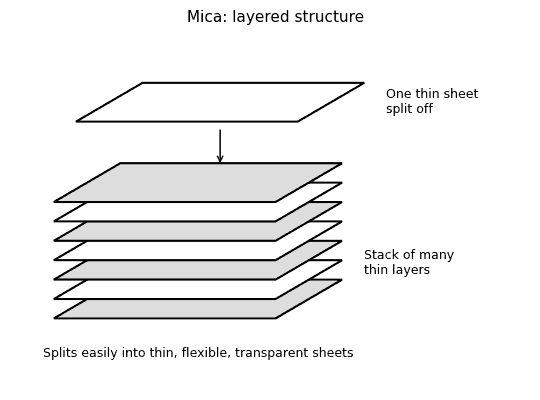 Fig. 1: Layered structure of mica
Diagram in words: A stack of many flat layers lies one over another. One thin sheet is lifted from the top, which shows that mica splits easily into thin sheets.
Properties:
- Very high dielectric strength and high resistivity.
- Very low dielectric loss.
- Withstands very high temperature without damage.
- Does not absorb moisture and resists chemicals.
- Resists corona and arcing.
- Flexible and elastic in thin sheets, but cannot be made into large pieces. Small pieces are bonded with shellac or resin to make micanite (built-up mica).
Applications:
- Insulation between the commutator segments of DC machines
- Slot insulation and insulation in machines working at high temperature
- Heating appliances such as irons, toasters and heaters
- Dielectric of capacitors; spacers in electronic valves
Exam tip: "Give the properties and applications of mica" has been asked as a 4-mark short question.
2. Asbestos
Asbestos is a natural mineral with soft, thread-like fibres. The fibres are spun or pressed into cloth, paper, tape and boards.
Properties: does not burn and resists very high temperature; resists chemicals; fair mechanical strength; absorbs moisture, which lowers its insulation; moderate electrical insulation.
Applications: insulation in heaters and furnaces, arc chutes of circuit breakers, fire-proof boards and switch board panels, high-temperature wire insulation.
Important point: Asbestos dust is very harmful to health. It causes lung diseases and cancer. Its use is banned or restricted in many countries, and safer materials are used instead.
3. Ceramic Materials: Porcelain and Steatite
Ceramics are made by shaping clay-type materials and firing them at high temperature.
3.1 Porcelain
Porcelain is made from clay, quartz and feldspar. It is shaped, glazed and fired. The shiny glaze makes the surface smooth, so water does not stick and dirt does not collect.
Properties:
- High dielectric strength and high resistivity.
- Very high mechanical (compressive) strength.
- Does not absorb water when glazed.
- Resists heat, weather and chemicals.
- Brittle and heavy.
Applications:
- Pin, suspension and strain insulators of overhead lines
- Bushings of transformers and circuit breakers
- Bodies of fuses, switch bases, lamp holders and cut-outs
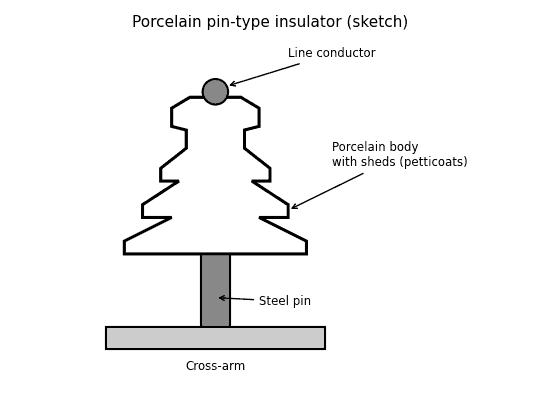 Fig. 2: Porcelain pin-type insulator (sketch)
Diagram in words: A steel pin is fixed on the cross-arm of the pole. A porcelain body with several umbrella-shaped sheds sits on the pin. The line conductor is tied in a groove at the top. The sheds make the leakage path long and keep the lower parts dry in rain.
Note: The figure is a sketch to show the idea. It is not to scale.
3.2 Steatite
Steatite is a ceramic made mainly from talc (magnesium silicate).
Properties: lower dielectric loss than porcelain, especially at high frequency; good mechanical strength; low moisture absorption; can be made in accurate sizes.
Applications: insulating parts of high-frequency equipment, coil formers, supports and bushes, heater parts.
Exam tip: Previous papers have asked whether porcelain or toughened glass is used for overhead line insulators (answer: both), and have asked that transformer bushings are made of porcelain.
4. Glass
Glass is made by melting silica (sand) with soda and lime and cooling it.
Properties:
- High dielectric strength and very high resistivity.
- Does not absorb water inside (non-porous), and resists chemicals.
- Transparent.
- Hard but brittle. Low tensile strength; toughened glass is much stronger.
Applications:
- Bulbs, tubes and glass bodies of cartridge fuses
- Toughened glass insulators on overhead lines
- Glass fibre cloth, tape and sleeving (heat-resistant insulation)
Exam tip: "Write any two properties of glass" has been asked as a one-mark question.
5. Fibrous and Natural Insulating Materials
| Material | Properties | Applications |
|---|---|---|
| Cotton | Cheap, flexible and strong; absorbs moisture, so it must be impregnated (Class Y when dry, Class A when impregnated) | Covering of winding wires, tapes, sleeves, varnished cloth |
| Silk | Thinner, stronger and smoother than cotton; high dielectric strength; costly | Covering of fine wires, thin tapes in instruments and telecom coils |
| Jute | Cheap and coarse; absorbs moisture; poor insulation unless treated | Bedding and serving over underground cables (soaked in bitumen), packing and filling |
| Wood | Dry wood is a fair insulator; absorbs moisture and burns; treated with oil or varnish for electrical use | Slot wedges, switchboard panels, tool handles, pole cross-arms, ladders |
The classes Y and A are explained in the temperature classification of insulating materials.
Important point: Silk and cotton wire coverings are now mostly replaced by synthetic fibres and enamels.
6. Paper (Dry and Impregnated)
Paper is made from wood pulp or cotton rags.
| Basis | Dry paper | Impregnated paper |
|---|---|---|
| Treatment | Used as it is | Soaked in oil, varnish or resin |
| Moisture absorption | High | Very low |
| Dielectric strength | Lower, falls when damp | Much higher and steady |
| Temperature class | Y | A |
| Uses | Slot lining and layer insulation in dry places | Paper-insulated cables, capacitors, transformer insulation |
7. Rubber
Natural rubber comes from the milky sap (latex) of the rubber tree. Synthetic rubbers are also made.
Properties: flexible and elastic; waterproof; good insulation; softens and ages with heat, sunlight and oil. Vulcanisation (heating with sulphur) makes it stronger, tougher and less sticky.
Applications: insulation and sheath of flexible cables, sleeves, insulating tape, mats and gloves used for safety.
8. Bitumen
Bitumen is a black, sticky material obtained from petroleum or found in nature.
Properties: waterproof, good adhesion, cheap, softens when heated and becomes brittle when very cold.
Applications: impregnating compound for paper, cotton and jute; filling compound in cable joint boxes and terminal boxes; moisture-proof coating.
9. Silicone Grease
Silicone grease is a smooth paste made from silicone oil and a filler. It is related to the silicone resins described in Plastics as Insulating Materials.
Properties: water repellent, stable over a wide temperature range (about −40 to 200 °C; approximate), chemically inert, good dielectric properties.
Applications: protects plug, socket and terminal contacts from moisture and corrosion, fills the gaps in high-voltage cable terminations and connectors, lubricates and seals rubber parts.
10. Insulating Varnishes and Enamels
Insulating varnish is a solution of resin or oil in a solvent. After the solvent dries, a hard, shiny insulating film remains.
Properties of a good varnish:
- Quick drying and setting hard, with a good surface.
- Chemical stability and resistance to oil and moisture.
- High dielectric strength and good adhesion.
- Good heat resistance.
Applications: coating of windings, impregnation of coils (dipping and baking), bonding and sealing of insulation.
Exam tip: A previous paper asked that a varnish used for coating, impregnation and adhesion should have all of these properties (quick drying, chemical stability, setting hard with a good surface).
Enamels for winding wires are special varnishes coated in thin layers on copper wire and baked on it. The wire is called enamelled wire (magnet wire). For the properties of copper itself, see Low Resistivity Materials: Silver, Gold, Copper, Aluminium, Steel, ACSR, Brass and Bronze.
- The coat is very thin and flexible, so more turns fit in the same slot.
- It has good dielectric strength and heat resistance.
- It is used for winding coils of motors, transformers, relays and fans.
11. Summary Table
| Material | Main feature | Main use |
|---|---|---|
| Mica | High temperature, high dielectric strength | Commutator insulation, heaters |
| Asbestos | Fire proof (but harmful dust) | Furnaces, arc chutes |
| Porcelain | Strong, glazed, weather resistant | Line insulators, bushings |
| Steatite | Low loss at high frequency | High-frequency parts |
| Glass | Transparent, non-porous | Insulators, fuse body, bulbs |
| Cotton, silk | Fibres, must be impregnated | Wire covering, tapes |
| Paper | Good when impregnated | Cables, capacitors |
| Rubber | Flexible, waterproof | Flexible cables, gloves |
| Bitumen | Waterproof sticky compound | Cable filling |
| Varnish, enamel | Dries to hard insulating film | Coil coating, magnet wire |
Everyday Examples to Remember
- The grey-white insulators on electric poles: porcelain (or toughened glass).
- The thin sheet inside an electric iron: mica.
- The shiny coating on the thin copper wire inside a fan motor: enamel.
- Rubber gloves and mats used by electricians: rubber.
MCQ and True/False Facts
- Porcelain and toughened glass insulators are both used on overhead power lines.
- Transformer bushings are made of porcelain.
- Mica is used between the commutator segments of DC machines.
- Varnish used for coating, impregnation and adhesion should dry quickly, be chemically stable and set hard with a good surface (all of these).
- Impregnated paper is better than dry paper.
- Asbestos is fire proof but its dust is harmful.
Important Questions for Examinations
Short Answer Questions
- Give the properties and applications of mica.
- Write the properties and applications of glass.
- Write the properties and applications of porcelain and steatite.
- Write a short note on asbestos.
- Write short notes on cotton, silk, jute and wood as insulating materials.
- Differentiate between dry paper and impregnated paper.
- Write short notes on rubber as an insulating material.
- Write short notes on bitumen and silicone grease.
- Write short notes on insulating varnishes and enamels for winding wires.
Long Answer Question
- Describe mica, asbestos, porcelain and glass as solid insulating materials with their properties and applications.
Quick Revision
- Mica: high temperature, splits in thin sheets, used in commutators and heaters.
- Asbestos: fireproof, harmful dust, use restricted.
- Porcelain: strong, glazed, for line insulators and bushings. Steatite: low loss at high frequency.
- Glass: transparent, non-porous, brittle. Toughened glass is used for line insulators.
- Cotton, silk, jute, paper and wood absorb moisture, so they are impregnated.
- Rubber (flexible), bitumen (waterproof filling), silicone grease (contact protection).
- Varnish: coating and impregnation of windings. Enamel: coating on winding wires.
Related Topics to Study Next
Before this note: Insulating Materials: Properties and Classification; Gaseous and Liquid Insulating Materials; Plastics as Insulating Materials.
Related reading: Insulating Material: Properties, Importance and Examples.
Next unit: Unit IV, Magnetic Materials: Classifications, Types and Important Terms.
Conclusion
Each solid insulator is chosen for one special strength: mica and asbestos for heat, porcelain and glass for overhead line insulators, fibres and paper for coverings and layers after impregnation, rubber for flexibility, bitumen for sealing, and varnish and enamel for coating windings. Remember each material with its one key property and one key use, and you will be ready for both short and long questions.
More notes in Electrical Engineering Materials
- Soft Magnetic Materials: Silicon Steel, C.R.G.O., Nickel-Iron, Mu Metal and Soft Ferrites
- Hysteresis Loss, Eddy Current Loss and Properties of Good Magnetic Materials
- Plastics as Insulating Materials: PVC, Bakelite, Epoxy Resin, Melamine, Teflon and Others
- Gaseous and Liquid Insulating Materials: Air, Nitrogen, SF6, Mineral Oil and Pyranol
- Insulating Materials: Properties and Classification
- Germanium and Silicon: Semiconductor Materials and Their Applications
Comments (0)
Sign in or create an account to leave a comment.
No comments yet.