Magnetic Materials : Classifications, Types and Important Terms
Ch. Devi Lal Government Polytechnic, Nathusari Chopta › Diploma in Engineering (Polytechnic) › Electrical Engineering › Semester 3
Magnetic Materials: What Are They?
If you are an engineering student, "magnetic materials" is a term you will meet in almost every branch. The idea is simple. A material that responds to an applied magnetic field, whether by being attracted (positive response) or repelled (negative response), is called a magnetic material. Strictly speaking, every substance responds to a magnetic field to some extent, but the response is extremely weak in most of them. In engineering, the term "magnetic materials" is mostly used for materials that respond strongly, such as iron, nickel and cobalt, because these are the ones we use in electrical machines and devices.Important Terms
Before classifying magnetic materials, let us understand a few basic terms.- Magnetic Flux Density (B): The magnetic flux passing through a unit area perpendicular to the field. Unit: tesla (T) or Wb/m².
- Magnetic Field Strength (H): Also called magnetising force or field intensity. It is the field produced by the current alone, independent of the material. Unit: A/m.
- Magnetisation (M): The magnetic moment per unit volume developed in a material. Unit: A/m.
- Permeability (μ): The ability of a material to allow magnetic flux to pass through it. μ = B/H. Unit: H/m.
- Relative Permeability (μr): The ratio of the permeability of a material to that of free space: μr = μ/μ₀, where μ₀ = 4π × 10⁻⁷ H/m. It has no unit.
- Magnetic Susceptibility (χ): The ratio of magnetisation to field strength: χ = M/H. It is related to relative permeability by μr = 1 + χ.
- Retentivity (Remanence): The flux density that remains in a material when the magnetising force is reduced to zero.
- Coercivity: The reverse magnetising force required to bring the residual flux density of a material back to zero.
- Saturation: The stage at which increasing H no longer causes a significant increase in B, because nearly all the magnetic domains are already aligned.
- Hysteresis Loss: The energy lost as heat in each cycle of magnetisation and demagnetisation. It is proportional to the area of the hysteresis loop.
- Reluctance (S): The opposition a material offers to the establishment of magnetic flux. S = l/(μA). Unit: AT/Wb.
- Curie Temperature: The temperature above which a ferromagnetic material loses its ferromagnetism and behaves like a paramagnetic material. For iron it is about 770°C.
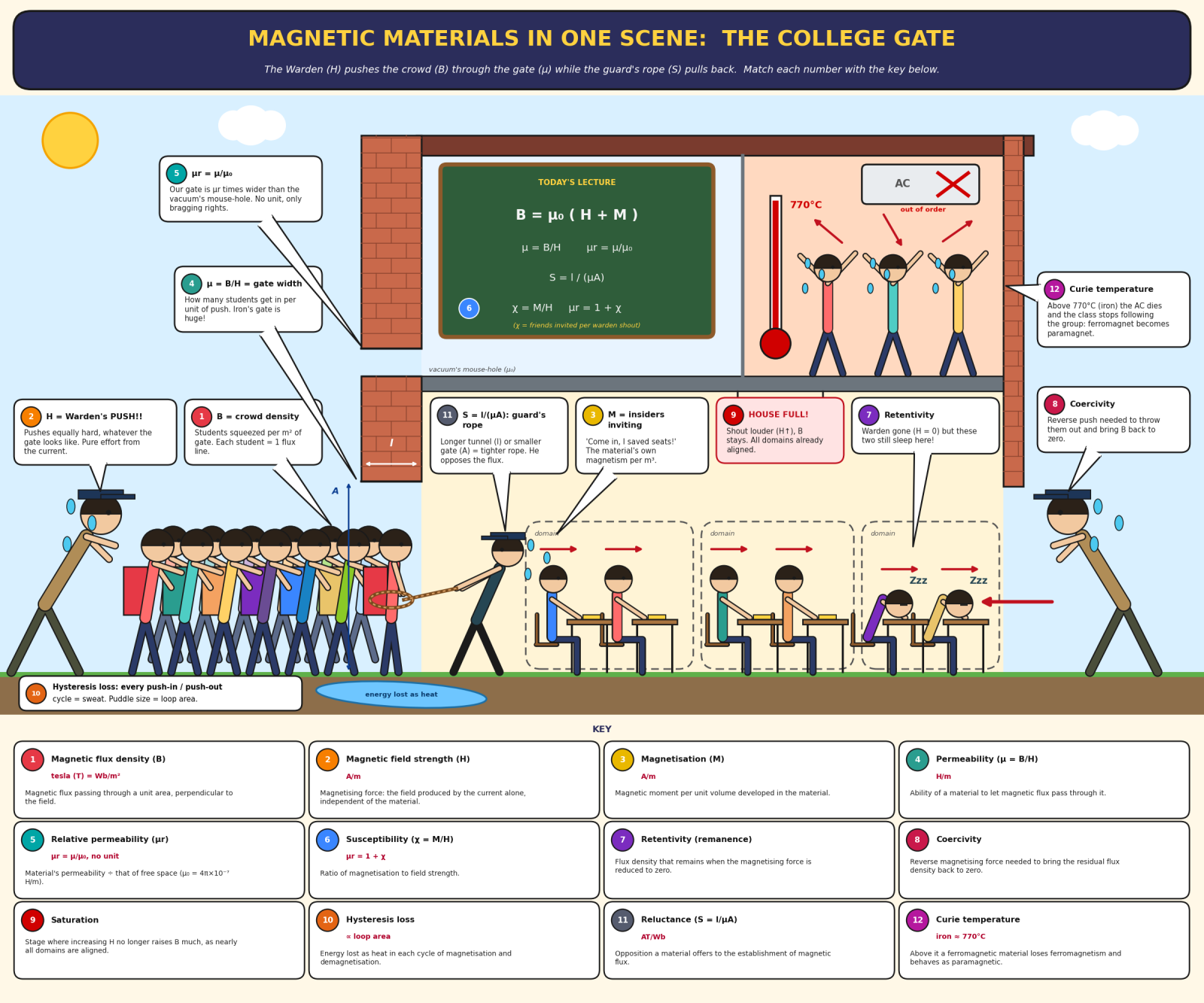
The warden’s push (H) drives a crowd of students (B) through a gate (μ). A guard pulling a rope (S, reluctance) opposes them. The wider the gate, the higher the permeability. Students already inside invite friends, which is the magnetisation M. When the classroom is full, shouting louder (more H) cannot raise B, and that is saturation.
When the warden leaves (H = 0), a few students stay asleep. That is retentivity. A reverse push is needed to remove them, and that is coercivity. The sweat from every fill-and-empty cycle is hysteresis loss, and it is proportional to the area of the hysteresis loop. At the Curie temperature (about 770°C for iron), discipline breaks down. The class stops following the group, and the ferromagnet becomes paramagnetic.
Formula to remember: B = μ₀(H + M)
The three main quantities are related by the equation: B = μ₀(H + M)Tip: Retentivity, coercivity, saturation and hysteresis loss are much easier to understand on a picture of the hysteresis loop. You will find one in Figure 2 later in this article, so come back to these definitions after you see it.
Classification of Magnetic Materials
A material can be classified in many ways depending on which property we consider. Magnetic materials are also classified on several bases, but the two most common are:- Classification on the basis of behaviour in a magnetic field
- Classification on the basis of the hysteresis loop
On the Basis of Behaviour in a Magnetic Field
This classification depends on how a material responds when it is placed in a magnetic field. On this basis there are three main types of magnetic materials, plus two further types that are important in practice. Figure 1 gives a quick, fun overview of the whole family before we study each member in detail.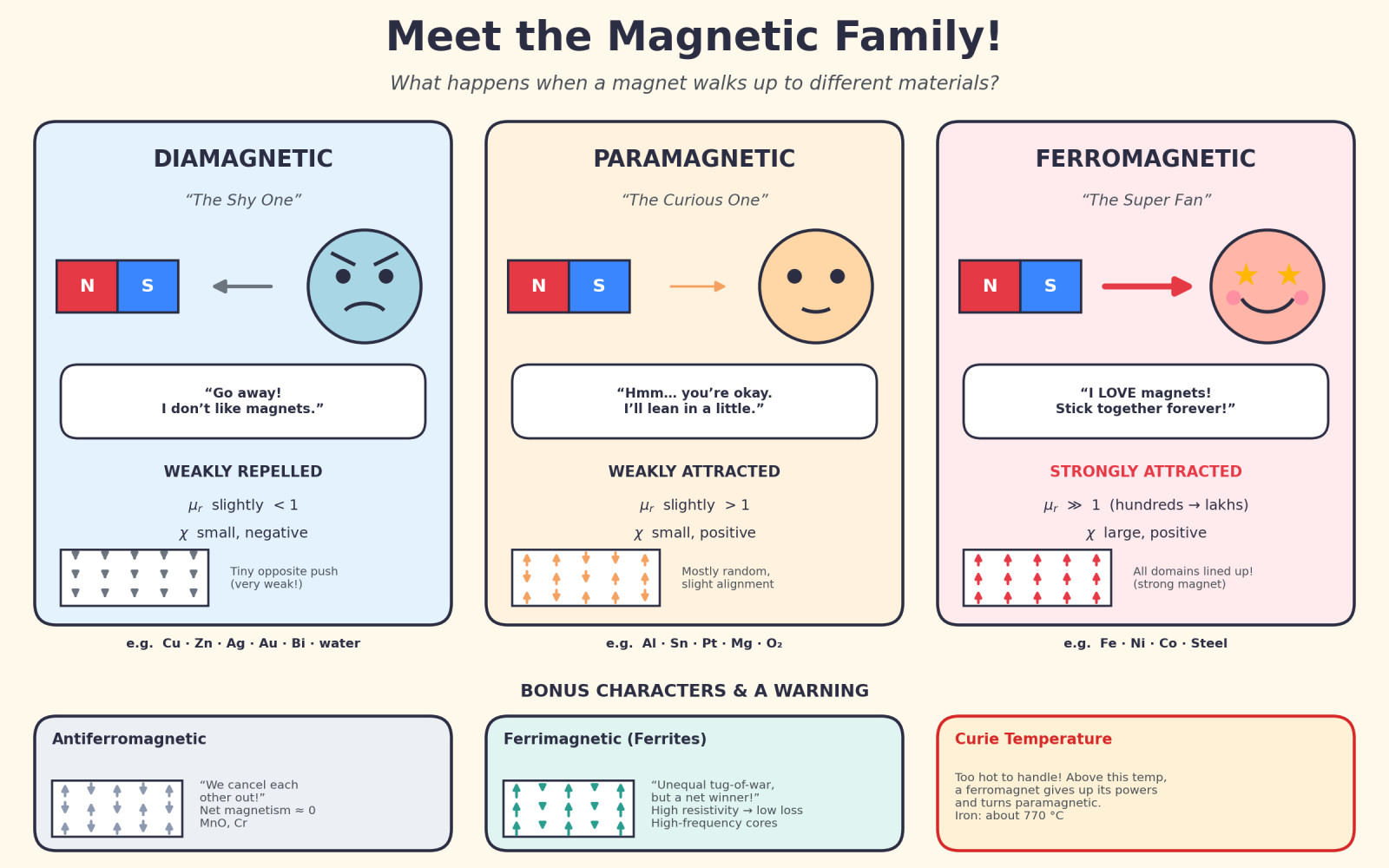
Figure 1: Meet the magnetic family. How diamagnetic, paramagnetic and ferromagnetic materials react to a magnet, with bonus characters.
- Diamagnetic Materials: A material that is weakly repelled by a magnetic field is called a diamagnetic material. Its relative permeability is slightly less than 1, and its susceptibility is small and negative. It becomes weakly magnetised in the direction opposite to the applied field. This property is almost independent of temperature. Examples: bismuth, zinc, silver, gold, copper, lead and water.
- Paramagnetic Materials: A material that is weakly attracted by a magnetic field is called a paramagnetic material. Its relative permeability is slightly greater than 1, and its susceptibility is small and positive. It becomes weakly magnetised in the same direction as the applied field. Its susceptibility decreases as the temperature rises (Curie's law). Examples: aluminium, tin, platinum, magnesium, manganese and oxygen.
- Ferromagnetic Materials: A material that is strongly attracted by a magnetic field is called a ferromagnetic material. Its relative permeability is very high (hundreds to hundreds of thousands), and it becomes strongly magnetised in the same direction as the applied field. This happens because the material is made of small regions called magnetic domains, in which the atomic magnetic moments are aligned. An external field aligns these domains, giving a very large magnetisation. Such a material can also retain magnetism after the field is removed. Above its Curie temperature it becomes paramagnetic. Examples: iron, steel, nickel and cobalt.
- Antiferromagnetic Materials: In these materials, neighbouring atomic magnetic moments are equal and opposite, so they cancel and the net magnetisation is almost zero. Examples: manganese oxide (MnO) and chromium.
- Ferrimagnetic Materials (Ferrites): Here the neighbouring moments are opposite but unequal, so a net magnetisation remains. Ferrites have high permeability and very high electrical resistivity, so eddy current losses are very low. This makes them ideal for high-frequency transformers, inductors and antennas. Examples: magnetite (Fe₃O₄), manganese-zinc ferrite and nickel-zinc ferrite.
| Property | Diamagnetic | Paramagnetic | Ferromagnetic |
|---|---|---|---|
| Response to field | Weakly repelled | Weakly attracted | Strongly attracted |
| Relative permeability (μr) | Slightly less than 1 | Slightly more than 1 | Very high (≫ 1) |
| Susceptibility (χ) | Small, negative | Small, positive | Large, positive |
| Effect of temperature | Almost none | Decreases as temperature rises | Lost above Curie temperature |
| Examples | Zinc, silver, copper, bismuth | Aluminium, tin, platinum | Iron, nickel, cobalt, steel |
On the Basis of the Hysteresis Loop
Ferromagnetic materials can also be classified by the shape and area of their hysteresis loop. A hysteresis loop is the closed curve obtained by plotting the magnetic flux density (B) against the magnetic field strength (H) as a material is taken through a complete cycle of magnetisation and demagnetisation. Figure 2 follows this cycle step by step. Start at point 1 and follow the numbers: the material reaches saturation (2), keeps some magnetism even when the current is off, which is its retentivity (3), needs a reverse push to lose it, which is its coercivity (4), and finally saturates in the opposite direction (5). The area enclosed by the loop is the energy lost as heat in every cycle. The figure also compares the thin loop of a soft material with the fat loop of a hard material.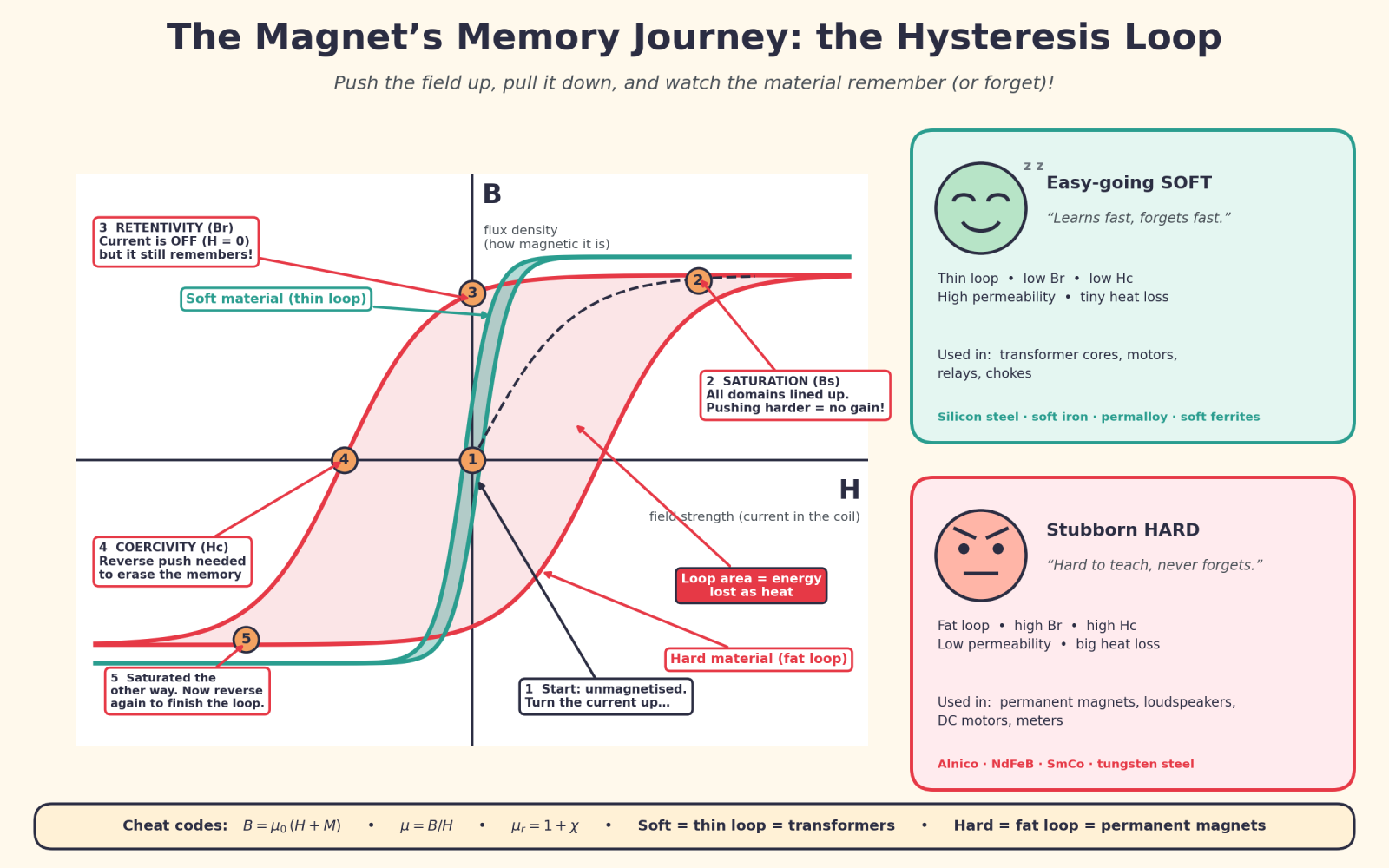
Figure 2: The hysteresis loop as a journey, showing saturation, retentivity, coercivity and loop area, with soft and hard magnetic materials compared.
- Soft Magnetic Materials: These materials are easily magnetised and demagnetised. They have a narrow (thin) hysteresis loop with a small loop area, which means low retentivity, low coercivity, high permeability and low hysteresis loss. They are used where the magnetisation reverses continuously, as in transformers, motors, generators, relays and chokes. Examples: silicon steel, soft iron, permalloy (nickel-iron alloy) and soft ferrites.
- Hard Magnetic Materials: These materials are difficult to magnetise and difficult to demagnetise. They have a wide (broad) hysteresis loop with a large loop area, which means high retentivity, high coercivity and large hysteresis loss. Once magnetised they keep their magnetism for a long time, so they are used as permanent magnets in loudspeakers, DC motors, magnetos and measuring instruments. Examples: alnico, tungsten steel, cobalt steel, hard ferrites, neodymium-iron-boron (NdFeB) and samarium-cobalt (SmCo).
| Property | Soft Magnetic Material | Hard Magnetic Material |
|---|---|---|
| Hysteresis loop | Narrow, small area | Wide, large area |
| Retentivity | Low | High |
| Coercivity | Low | High |
| Permeability | High | Low |
| Hysteresis loss | Small | Large |
| Magnetisation | Easy to magnetise and demagnetise | Hard to magnetise and demagnetise |
| Use | Transformers, motors, relays, chokes | Permanent magnets, speakers, meters |
| Examples | Silicon steel, soft iron, permalloy | Alnico, NdFeB, tungsten steel |
Quick Revision
- Diamagnetic: weakly repelled, μr < 1. Paramagnetic: weakly attracted, μr slightly > 1. Ferromagnetic: strongly attracted, μr ≫ 1 (see Figure 1).
- Ferromagnetism comes from magnetic domains and disappears above the Curie temperature.
- On the hysteresis loop, retentivity is the B left at H = 0, coercivity is the reverse H needed to bring B to zero, and the loop area is the energy lost as heat (see Figure 2).
- Soft magnetic materials have a narrow loop and low loss, so they suit transformer cores and machines.
- Hard magnetic materials have a wide loop and high retentivity and coercivity, so they suit permanent magnets.
- Ferrites combine good magnetic properties with high resistivity, so they suit high-frequency applications.
- Differentiate between diamagnetic, paramagnetic and ferromagnetic materials.
- What is a hysteresis loop? Define retentivity and coercivity.
- Differentiate between soft and hard magnetic materials with examples and applications.
- Why is silicon steel used for transformer cores?
- What is Curie temperature?
More notes in Electrical Engineering Materials
- Electrical Engineering Materials Previous Year Questions: Unit-wise 1 Mark, Short and Long Answer Questions
- Hard Magnetic Materials: Tungsten Steel, Chromium Steel, Cobalt Steel, Alnico and Hard Ferrites
- Materials Used in the Fabrication of Motors and Generators: Part-wise Materials and Reasons
- Materials Used in the Fabrication of a Transformer: Part-wise Materials and Reasons
- Soldering, Bimetals and Fuses: Solder Materials, Bimetallic Strip and Fuse Wire
- Thermocouples: Principle, Working, Materials and Applications
Comments (0)
Sign in or create an account to leave a comment.
No comments yet.