Insulating Materials: Properties and Classification
Ch. Devi Lal Government Polytechnic, Nathusari Chopta › Diploma in Engineering (Polytechnic) › Electrical Engineering › Semester 3
Insulating Materials: Properties and Classification
You do not get a shock when you touch an electric wire because the wire is covered with plastic. That cover is an insulating material. It keeps the current inside the wire and keeps you safe.
In this note you will learn what makes a good insulating material, which properties matter most, and how insulators are grouped by the temperature they can bear. To see why insulation is so important in machines, read Insulating Material: Properties, Importance and Examples.
1. What Are Insulating Materials?
Definition: Insulating materials (insulators or dielectrics) are materials that do not allow electric current to flow through them under normal conditions.
They have very high resistivity because they have almost no free electrons. In the energy band picture, the forbidden gap between the valence band and the conduction band is very large. Compare this with conducting materials, which have free electrons and low resistivity, and with semiconductors, which have a small gap. The full comparison is in Classification of Electrical Engineering Materials.
Examples: air, mineral oil, PVC, rubber, glass, porcelain, mica, paper, dry wood.
Functions of an insulating material:
- It keeps the current in its proper path, for example inside the wire.
- It separates conductors that are at different voltages.
- It protects people from electric shock.
- It supports the live parts of equipment, as in line insulators.
2. Types of Insulating Materials
On the basis of physical state, insulating materials are of three types.
| Type | Examples | Typical use |
|---|---|---|
| Gaseous | Air, nitrogen, SF6 | Overhead lines, circuit breakers, gas insulated equipment |
| Liquid | Mineral oil, Pyranol | Transformers, switchgear, capacitors |
| Solid | PVC, rubber, glass, porcelain, mica, paper | Cables, line insulators, windings |
These are studied one by one in the next notes.
3. Characteristics of a Good Insulating Material
- Very high resistivity (very high insulation resistance).
- High dielectric strength.
- Low dielectric loss.
- High melting point and good heat resistance. (A True/False question has asked this. The melting point of an insulator should be high, so a statement saying it should not be high is False.)
- Good mechanical strength.
- Low moisture absorption.
- Chemical stability and long life.
- Low cost and easy availability.
4. Electrical Properties of Insulating Materials
Exam tip: "Explain the electrical properties of insulating materials" and "Describe the dielectric strength of insulating materials" have each been asked as 4-mark short questions.
- Volume resistivity and insulation resistance: Resistivity should be very high so that the leakage current through the material is extremely small. Moisture and high temperature lower it.
- Surface resistivity: Current can also creep along the surface of an insulator if it is wet or dirty. A glazed or water-repellent surface keeps this leakage low.
- Dielectric strength: explained in detail below.
- Dielectric loss: When an insulator is used with an alternating voltage, some energy is lost as heat inside it. Dielectric loss should be low, otherwise the insulator heats up. For loss angle and its calculation, see Dielectric Material, Dielectric Strength, Dielectric Loss and Loss Angle.
- Dielectric constant (permittivity): It tells how well the material can store electric charge. It should be low for cable insulation and high for the material of capacitors.
4.1 Dielectric Strength
Definition: Dielectric strength is the maximum voltage that an insulating material can bear per unit thickness without breaking down. It is measured in kV/mm.
If the voltage becomes too high, the insulator suddenly starts to conduct. This is called breakdown. A spark passes through the material, and it may be permanently damaged (solids) or may recover (gases and liquids).
Dielectric strength = breakdown voltage / thickness of the material.
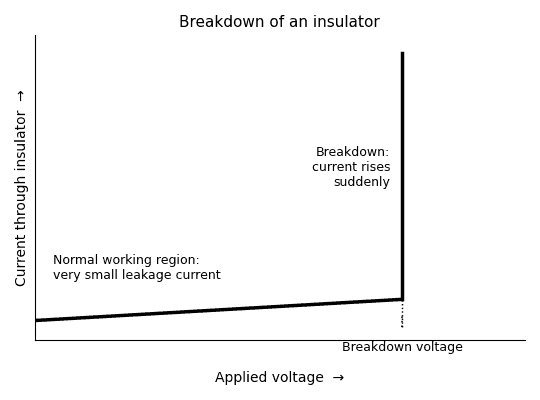 Fig. 1: Breakdown of an insulator
Diagram in words: The horizontal axis is the applied voltage and the vertical axis is the current through the insulator. Up to the breakdown voltage the current is extremely small. At the breakdown voltage the current rises suddenly and the insulator fails.
Factors that lower dielectric strength: moisture, dust and impurities, high temperature, and increased thickness of the material (the strength per mm falls).
Example (approximate): Air breaks down at about 3 kV/mm. Good insulating oil and solid insulators can bear many times more. These are textbook values and are not given in the syllabus.
5. Thermal Properties of Insulating Materials
Heat is the biggest enemy of insulation. Losses in a machine produce heat, and heat makes insulation age and fail. The important thermal properties are:
- Heat resistance (melting or softening point): The material should not melt, soften or burn at the working temperature.
- Thermal conductivity: Insulation should pass heat from the winding to the outside easily so that the winding does not overheat. Most insulators are poor conductors of heat, so thin layers are used.
- Thermal stability and ageing: Its electrical and mechanical properties should not worsen with time at high temperature. A common rule of thumb is that insulation life roughly halves for every 8 to 10 °C rise above the rated temperature.
- Low thermal expansion: It should not crack when it heats and cools repeatedly.
- Fire resistance: It should not catch fire easily or help a fire to spread.
Exam tip: "Explain the thermal properties of insulating materials" has been asked as a 4-mark short question.
6. Mechanical Properties of Insulating Materials
- Tensile and compressive strength: The material should not break when pulled or pressed. Line insulators carry the weight of heavy conductors.
- Flexibility: Cable and wire insulation should bend without cracking.
- Hardness and abrasion resistance: The surface should not wear off easily.
- Impact strength: It should withstand shocks and vibration without breaking.
- Machinability: It should be easy to cut, drill, mould or shape into the required form.
Exam tip: "Explain in brief mechanical properties of insulating material" has been asked as a 4-mark short question.
7. Chemical, Visual and Physical Properties
| Property | Meaning | Why it matters |
|---|---|---|
| Chemical | Resistance to acids, alkalis, oils, solvents, moisture and gases | Insulation must not be attacked by its surroundings, and it must not corrode the conductor |
| Visual | Appearance: colour, transparency, surface finish | Colour helps in identifying wires; a smooth surface collects less dirt; transparency helps to see inside (for example, glass) |
| Physical | Density, porosity, moisture absorption, viscosity (for liquids), flash point | A porous material absorbs moisture and loses insulation; a light material makes equipment lighter |
8. Classification of Insulating Materials by Temperature
Every insulating material can safely work only up to a certain temperature. If it runs hotter for a long time, it ages quickly. On this basis, insulating materials are divided into classes. The class is decided by the maximum permissible (working) temperature.
| Class | Maximum temperature (°C) | Typical materials |
|---|---|---|
| Y | 90 | Cotton, silk, paper (not impregnated), wood |
| A | 105 | Cotton, silk and paper impregnated with oil or varnish; enamel on wires |
| E | 120 | Some synthetic enamels and films |
| B | 130 | Mica, glass fibre and asbestos with organic binders |
| F | 155 | Mica and glass fibre with epoxy or polyester resins |
| H | 180 | Silicone resins, silicone rubber, mica and glass fibre with silicone |
| C | Above 180 | Mica, glass, porcelain and quartz without binder, Teflon |
Note: The temperature limits and example materials are standard textbook values and are not given in the syllabus. The list of materials differs a little between books.
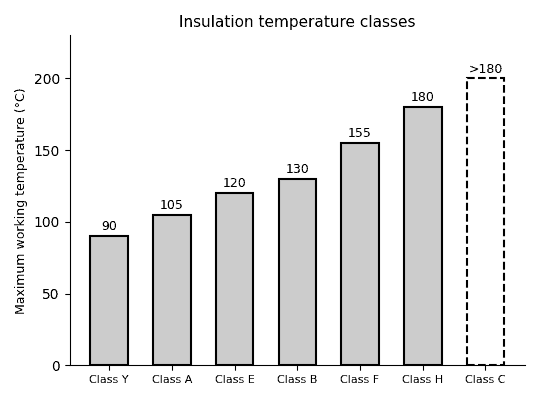 Fig. 2: Maximum working temperature of insulation classes
Diagram in words: Seven bars stand side by side for classes Y, A, E, B, F, H and C. The bars become taller from left to right: 90, 105, 120, 130, 155 and 180 °C. The last bar (Class C) has a dashed outline, which shows that its limit is above 180 °C.
Important point: The order of classes by temperature is Y, A, E, B, F, H, C. Class E is 120 °C. A previous paper asked this as a one-mark MCQ.
Exam tip: "Explain the thermal classification of insulating material" has been asked as a 4-mark short question. Write the table and one line on why classes are needed.
Everyday Examples to Remember
- The plastic cover on a phone charger cable: solid insulator.
- The oil inside a pole-mounted transformer: liquid insulator and coolant.
- The air gap between overhead lines: gaseous insulator.
- A motor that gets very hot uses higher-class insulation (F or H) than a ceiling fan (Class A or E).
MCQ and True/False Facts
- Class E insulation has a working temperature of 120 °C.
- The melting point of an insulator should be high. The statement "should not be high" is False.
- Air is an example of an insulating material (True).
- Plastic is a bad conductor of electricity.
- The forbidden energy gap is largest in insulators.
- In an insulator, the valence band and conduction band have a large gap.
Important Questions for Examinations
Short Answer Questions
- Explain the electrical properties of insulating materials.
- Describe the dielectric strength of insulating materials.
- Explain the thermal properties of insulating materials.
- Explain in brief the mechanical properties of insulating materials.
- Explain the thermal classification of insulating materials.
- What are the characteristics of a good insulating material? Name its chemical, visual and physical properties.
Long Answer Question
- Discuss the characteristics of a good insulating material. Explain its electrical, thermal and mechanical properties and the classification of insulating materials on the basis of temperature.
Quick Revision
- Insulators have very high resistivity and a very large forbidden gap.
- Three types: gaseous, liquid and solid.
- Dielectric strength = breakdown voltage / thickness (kV/mm).
- Electrical properties: resistivity, dielectric strength, dielectric loss, dielectric constant.
- Thermal properties: heat resistance, thermal conductivity, ageing, expansion, fire resistance.
- Mechanical properties: tensile and compressive strength, flexibility, hardness, impact strength.
- Temperature classes: Y 90, A 105, E 120, B 130, F 155, H 180, C above 180 °C.
Related Topics to Study Next
Before this note: Classification of Electrical Engineering Materials, Conducting Materials: Basics and Semiconductor Fundamentals.
Related reading: Insulating Material: Properties, Importance and Examples and Dielectric Material, Dielectric Strength, Dielectric Loss and Loss Angle.
Next: Gaseous and Liquid Insulating Materials; Plastics as Insulating Materials; Mica, Asbestos, Ceramics, Glass and Other Solid Insulators.
Conclusion
A good insulating material has very high resistivity, high dielectric strength, low loss, good heat resistance and enough mechanical strength. Insulators are placed in classes Y to C according to the highest temperature they can bear for long periods. Choosing the right class of insulation keeps motors, transformers and cables safe and long-lasting.
More notes in Electrical Engineering Materials
- Soft Magnetic Materials: Silicon Steel, C.R.G.O., Nickel-Iron, Mu Metal and Soft Ferrites
- Hysteresis Loss, Eddy Current Loss and Properties of Good Magnetic Materials
- Mica, Asbestos, Ceramics, Glass and Other Solid Insulating Materials
- Plastics as Insulating Materials: PVC, Bakelite, Epoxy Resin, Melamine, Teflon and Others
- Gaseous and Liquid Insulating Materials: Air, Nitrogen, SF6, Mineral Oil and Pyranol
- Germanium and Silicon: Semiconductor Materials and Their Applications
Comments (0)
Sign in or create an account to leave a comment.
No comments yet.