Gaseous and Liquid Insulating Materials: Air, Nitrogen, SF6, Mineral Oil and Pyranol
Ch. Devi Lal Government Polytechnic, Nathusari Chopta › Diploma in Engineering (Polytechnic) › Electrical Engineering › Semester 3
Gaseous and Liquid Insulating Materials: Air, Nitrogen, SF6, Mineral Oil and Pyranol
Insulators are not only solids. The air between two overhead wires is an insulator. The oil in a transformer is an insulator too, and it also takes heat away. In this note we study the gaseous and liquid insulating materials named in the syllabus.
Before reading this note, see Insulating Materials: Properties and Classification for the properties used here. For the basics of why insulation is needed, read Insulating Material: Properties, Importance and Examples. For dielectric strength, which is used throughout this note, see Dielectric Material, Dielectric Strength, Dielectric Loss and Loss Angle.
1. Gaseous Insulating Materials
Gases are good insulators because their molecules are far apart and there are very few free charges. Gaseous insulation does not wear out. If a gas breaks down, it recovers by itself when the voltage is removed (self-restoring insulation).
1.1 Air
Properties:
- Free of cost and available everywhere.
- Dielectric strength is about 3 kV/mm at normal pressure (approximate).
- Self-restoring: it recovers after a spark.
- Its strength falls when it is damp or at high altitude, where the pressure is low.
- It supports burning (it contains oxygen), and it slowly oxidises metal parts.
Applications:
- Insulation between overhead transmission and distribution lines
- Insulation between bus bars and live parts in open-type substations
- Air-break switches and air-blast circuit breakers
- Dielectric in air capacitors (variable capacitors)
Exam tip: "Air is an example of insulating material (True/False)" has been asked. The answer is True.
1.2 Nitrogen
Properties:
- Colourless, odourless and chemically inert gas.
- Does not burn and does not support burning.
- Does not oxidise or corrode parts, as it contains no oxygen.
- Dielectric strength is similar to or a little higher than air.
- Cheap and easily available (about four-fifths of air is nitrogen).
Applications:
- Filling in gas-filled capacitors and cables under pressure
- Gas cushion above the oil in some sealed transformers, to keep oxygen and moisture away from the oil
- Inert atmosphere in some high-voltage test equipment
1.3 Sulphur Hexafluoride (SF6)
SF6 is an artificial gas made from sulphur and fluorine. One molecule has one sulphur atom joined to six fluorine atoms.
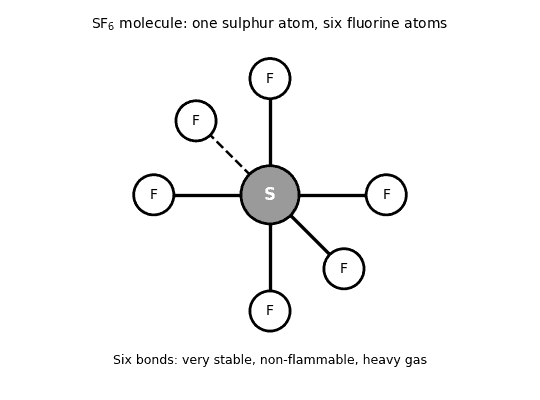 Fig. 1: SF6 molecule
Diagram in words: A grey circle marked S (sulphur) is in the centre. Six white circles marked F (fluorine) are joined to it by lines, one on each side: up, down, left, right, front and back. The six strong bonds make the gas very stable.
Properties:
- Colourless, odourless, non-toxic (in pure form) and non-flammable.
- Very heavy: about five times heavier than air.
- High dielectric strength, about 2.5 times that of air at the same pressure (approximate). The strength increases further as pressure increases.
- Excellent arc-quenching property: its molecules catch free electrons, so the arc dies quickly.
- Chemically stable and inert at normal temperature.
- Good heat-carrying ability.
Applications:
- SF6 circuit breakers for high-voltage lines
- Gas-insulated substations (GIS), which need much less space than air-insulated ones
- High-voltage cables, transformers and switchgear
Important point: SF6 is a strong greenhouse gas. It must not be released into the air, and its decomposition products after arcing are poisonous, so it is handled with care.
Exam tip: "Write the properties and applications of SF6" has been asked in two papers (once together with Bakelite). It is a high-priority 4-mark question.
2. Liquid Insulating Materials
Liquids have higher dielectric strength than gases. A liquid also fills small gaps and carries heat away by circulating. So a liquid insulator does two jobs: insulation and cooling.
2.1 Mineral Oil (Insulating Oil)
Mineral oil is obtained from petroleum by refining. It is the most widely used liquid insulator in transformers, switchgear and cables.
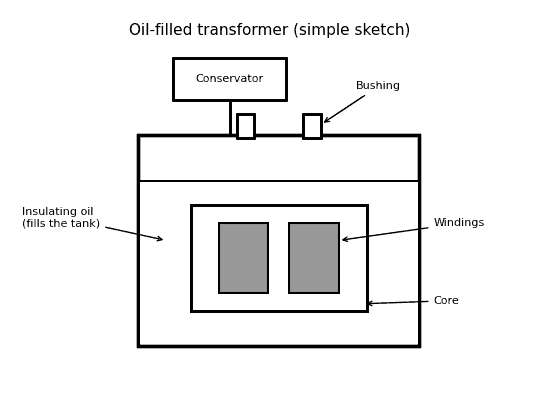 Fig. 2: Oil-filled transformer (simple sketch)
Diagram in words: A big tank holds the core and two windings. The tank is filled with insulating oil up to a marked level. On top, two bushings carry the connections out. A small tank called the conservator is joined by a pipe to the main tank and takes up the expansion of the oil when it heats.
Properties:
- High dielectric strength (about 10–15 kV/mm for clean, dry oil; approximate).
- Low viscosity, so it flows easily and cools the windings by circulation.
- High flash point (it does not catch fire easily) and low pour point (it does not freeze in cold weather).
- Good chemical stability: it does not form much sludge in service.
- Low moisture content. Even a small amount of water lowers its dielectric strength a lot.
Applications:
- Power and distribution transformers (insulation and cooling)
- Oil circuit breakers (insulation and arc quenching)
- Switchgear, oil-filled cables and capacitors
Limitations: It is flammable, it slowly oxidises and forms sludge, and it absorbs moisture. So transformer oil is tested and filtered regularly.
Exam tip: "Enlist the properties of insulating oil" has been asked as part of a 4-mark short question (together with epoxy resin).
2.2 Pyranol (Synthetic Insulating Liquid)
Pyranol is the trade name of a synthetic insulating liquid. It belongs to the chlorinated hydrocarbon group (also called askarel). It was made as a non-burning alternative to mineral oil.
Properties:
- Non-flammable (it does not burn easily).
- High dielectric constant, so it is good for capacitors.
- High dielectric strength and good chemical stability.
- Does not form sludge easily.
Applications:
- Capacitors
- Transformers used in places where fire is a big risk
Important point: Liquids of the Pyranol type are poisonous and do not break down in nature, so their use is now banned or strictly restricted in many countries. Safer synthetic liquids (for example silicone liquids and synthetic esters) are used instead. This safety note is not part of the syllabus text, but it is useful to know.
3. Comparison of Gaseous and Liquid Insulators
| Basis | Gaseous insulators | Liquid insulators |
|---|---|---|
| Examples | Air, nitrogen, SF6 | Mineral oil, Pyranol |
| Dielectric strength | Lower (air about 3 kV/mm) | Higher (oil about 10–15 kV/mm) |
| Recovery after breakdown | Self-restoring | Mostly recovers, but oil may form carbon |
| Cooling | Poor (except SF6 under pressure) | Good, by circulation |
| Use | Overhead lines, circuit breakers, GIS | Transformers, switchgear, capacitors |
Everyday Examples to Remember
- The air gap between two wires on a pole: air as an insulator.
- The oil tank of a transformer on the road: mineral oil for insulation and cooling.
- A 132 kV or 220 kV substation in a closed hall: SF6 gas-insulated.
MCQ and True/False Facts
- Air is an insulating material (True).
- The full form of SF6 is sulphur hexafluoride.
- SF6 is used for arc quenching in circuit breakers.
- Mineral oil is used in transformers for insulation and cooling.
- Pyranol is a synthetic insulating liquid.
Important Questions for Examinations
Short Answer Questions
- Write the properties and applications of SF6.
- Write the properties and applications of insulating (mineral) oil.
- Write short notes on air and nitrogen as gaseous insulating materials.
- Write a short note on Pyranol.
- Compare gaseous and liquid insulating materials.
Long Answer Question
- Discuss gaseous and liquid insulating materials with their properties and applications.
Quick Revision
- Gaseous insulators: air, nitrogen, SF6. Self-restoring.
- SF6: heavy, non-toxic, non-flammable, strength about 2.5 times air, excellent arc quenching. Used in circuit breakers and GIS.
- Mineral oil: insulation plus cooling in transformers and switchgear. Keep it dry.
- Pyranol: synthetic, non-flammable liquid used in capacitors. Now restricted because it is harmful.
Related Topics to Study Next
Before this note: Insulating Materials: Properties and Classification. Related reading: Insulating Material: Properties, Importance and Examples, Dielectric Material, Dielectric Strength, Dielectric Loss and Loss Angle and Classification of Electrical Engineering Materials.
Next: Plastics as Insulating Materials; Mica, Asbestos, Ceramics, Glass and Other Solid Insulators.
Conclusion
Air is the cheapest insulator, nitrogen is a safe inert gas, and SF6 is the best gas for high-voltage breakers because it is strong and quenches arcs fast. Mineral oil insulates and cools transformers, and Pyranol was used where fire risk was high. Knowing the advantage and limit of each helps you choose the right one.
More notes in Electrical Engineering Materials
- Soft Magnetic Materials: Silicon Steel, C.R.G.O., Nickel-Iron, Mu Metal and Soft Ferrites
- Hysteresis Loss, Eddy Current Loss and Properties of Good Magnetic Materials
- Mica, Asbestos, Ceramics, Glass and Other Solid Insulating Materials
- Plastics as Insulating Materials: PVC, Bakelite, Epoxy Resin, Melamine, Teflon and Others
- Insulating Materials: Properties and Classification
- Germanium and Silicon: Semiconductor Materials and Their Applications
Comments (0)
Sign in or create an account to leave a comment.
No comments yet.