Materials Used in the Fabrication of a Transformer: Part-wise Materials and Reasons
Ch. Devi Lal Government Polytechnic, Nathusari Chopta › Diploma in Engineering (Polytechnic) › Electrical Engineering › Semester 3
Materials Used in the Fabrication of a Transformer: Part-wise Materials and Reasons
A transformer looks simple from outside, but every part inside is made from a carefully chosen material. The core must carry magnetic flux, the windings must carry current, the insulation must stop short circuits, and the oil must cool everything. This is the most repeated long question in the papers: in two of the four papers it has been asked for 8 marks, in the form "write the engineering materials needed to fabricate a transformer, along with the part names, and explain the reasons".
This note brings together what you learned in the earlier units (conductors, insulators and magnetic materials) and applies it to a transformer. The best way to answer is part by part: part name, material, reason.
1. Main Parts of a Transformer
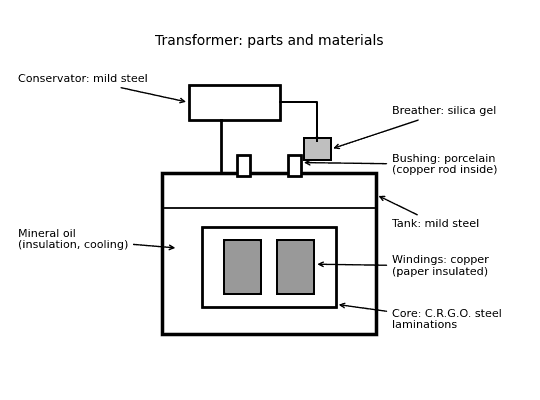 Fig. 1: Parts of an oil-filled transformer and their materials
Diagram in words: A rectangular tank holds a core with two windings, and it is filled with oil. On top of the tank are two bushings. A smaller tank, the conservator, is joined to the main tank by a pipe, and a small breather filled with silica gel is fixed to the conservator. Labels give the material of each part.
2. Core
Material: C.R.G.O. (cold rolled grain oriented) silicon steel laminations, about 0.23 to 0.35 mm thick (approximate). Small and high-frequency transformers use silicon steel or ferrites.
Reasons:
- High permeability, so the flux passes easily with a small magnetising current.
- Grain orientation gives very low hysteresis loss along the direction of flux.
- Silicon increases resistivity, and thin insulated laminations break the paths of eddy currents. So eddy current loss is small.
- The flux in a transformer always flows in one fixed direction, so grain-oriented steel can be used.
See Soft Magnetic Materials for more on C.R.G.O.
3. Windings
Material: copper (generally) or aluminium. Small transformers use round enamelled wire. Large transformers use rectangular copper strip.
Reasons:
- Low resistivity, so copper loss (I2R) and voltage drop are small.
- Ductile and flexible, so it is easily wound into coils.
- High tensile strength to bear the forces on windings during short circuits.
- Easy to solder and join.
- Aluminium is lighter and cheaper but needs a larger cross-section, and joining is harder, so it is used in some distribution transformers.
4. Insulation
| Where | Material | Reason |
|---|---|---|
| On the winding wire | Enamel (small transformers); paper or cotton tape (large transformers) | Thin film, good dielectric strength, little space taken |
| Between windings and between layers | Paper impregnated with oil, press-board, varnished cloth | High dielectric strength and Class A rating (105 °C) in oil |
| Between core, windings and clamps | Press-board, Bakelite, epoxy (cylinders, spacers, blocks) | Strong, good insulator, resists oil and heat |
| Between laminations | Thin varnish or oxide coating | Stops eddy current flow between sheets |
| Dry-type transformers | Epoxy resin, glass fibre, mica, silicone | Heat resistant, no oil needed (Class F or H) |
5. Insulating and Cooling Medium
Material: mineral (transformer) oil.
Reasons:
- High dielectric strength, so it insulates the windings and the core.
- Low viscosity, so it circulates and takes heat from the windings to the tank walls.
- High flash point and chemical stability.
- It fills the pores of paper insulation and removes air bubbles.
See Gaseous and Liquid Insulating Materials for the properties of oil.
6. Tank, Conservator and Radiators
Material: mild steel (welded sheet), painted with oil-resistant paint.
Reasons: strong enough to hold the core, windings and oil; cheap; easy to weld and shape; can be corrugated or fitted with radiator fins to increase the cooling surface. The conservator (an expansion tank on top) is also made of mild steel.
7. Bushings
Material: porcelain (high-voltage bushings) with a copper or brass conductor rod inside. Low-voltage bushings may be of Bakelite or epoxy.
Reasons: porcelain has high dielectric strength, high mechanical strength, resists weather, and its glazed and shed-shaped surface does not collect water and dirt. Copper or brass inside gives good conductivity.
Exam tip: "Transformer bushings are made of ___" has been asked as a one-mark question. Write porcelain.
8. Breather, Gaskets and Other Parts
| Part | Material | Reason |
|---|---|---|
| Breather | Silica gel crystals | Absorb the moisture of the air entering the conservator, so the oil stays dry |
| Gaskets and seals | Cork or oil-resistant synthetic rubber | Prevent oil leakage and keep out moisture |
| Core clamps and frame | Mild steel channels and bolts (bolts are insulated) | Hold the core tight and bear the forces |
| Terminals and tap connections | Copper or brass | Good conductivity, easy to solder and tighten |
9. Complete Summary Table
| Part | Material | Main reason |
|---|---|---|
| Core | C.R.G.O. silicon steel laminations | High permeability, low hysteresis and eddy loss |
| Windings | Copper (or aluminium) | Low resistivity, ductile, strong |
| Winding insulation | Enamel, paper, cotton tape | High dielectric strength |
| Insulating spacers and cylinders | Press-board, Bakelite, epoxy | Strong and insulating |
| Oil | Mineral oil | Insulation and cooling |
| Tank, conservator | Mild steel | Strong, cheap, weldable |
| Bushings | Porcelain with copper rod | Insulating, weather proof |
| Breather | Silica gel | Absorbs moisture |
| Gaskets | Cork, synthetic rubber | Prevent leakage |
Note: The thicknesses and the choice of material for a given transformer differ between makers and ratings. The values given are textbook values and are not given in the syllabus.
Everyday Examples to Remember
- The grey oil-filled transformer on an electric pole: steel tank, porcelain bushings, copper or aluminium winding, oil inside.
- The small black adapter or mobile charger: a small transformer with a ferrite or silicon steel core and an enamelled copper winding.
MCQ and True/False Facts
- Transformer bushings are made of porcelain.
- The transformer core is made of C.R.G.O. silicon steel laminations.
- Winding conductor of a transformer: copper (or aluminium).
- Transformer oil is used for insulation and cooling.
- High-frequency transformer cores are made from ferrites.
- Silica gel in the breather absorbs moisture.
Important Questions for Examinations
Short Answer Questions
- Name the material used for the transformer core and give the reasons for choosing it.
- Write the materials used for the windings of a transformer. Compare copper and aluminium for this use.
- Write the insulating materials used in a transformer and the place where each is used.
- Write the materials of the tank, bushings, breather and gaskets of a transformer, with reasons.
Long Answer Question
- Write the various engineering materials necessary for the fabrication of a transformer along with their part names. Also explain the reasons for using these materials for that particular application.
Quick Revision
- Core: C.R.G.O. silicon steel laminations (low hysteresis and eddy loss).
- Windings: copper (or aluminium) with enamel or paper insulation.
- Oil: mineral oil for insulation and cooling.
- Tank and conservator: mild steel. Bushings: porcelain. Breather: silica gel. Gaskets: cork or rubber.
- Dry-type: epoxy, glass fibre and mica instead of oil.
Related Topics to Study Next
Before this note: Soft Magnetic Materials; Low Resistivity Materials; Gaseous and Liquid Insulating Materials. Next: Materials Used in the Fabrication of Motors and Generators.
Conclusion
Every part of a transformer uses the material that suits its job: C.R.G.O. steel for the core to keep losses low, copper for the windings to carry current, paper and enamel to insulate, oil to insulate and cool, mild steel for the tank and porcelain for the bushings. In the exam, always write the answer as part, material and reason.
More notes in Electrical Engineering Materials
- Hard Magnetic Materials: Tungsten Steel, Chromium Steel, Cobalt Steel, Alnico and Hard Ferrites
- Materials Used in the Fabrication of Motors and Generators: Part-wise Materials and Reasons
- Soldering, Bimetals and Fuses: Solder Materials, Bimetallic Strip and Fuse Wire
- Thermocouples: Principle, Working, Materials and Applications
- High Resistivity Materials: Constantan, Nichrome, Manganin, Tungsten, Carbon and Others
- Soft Magnetic Materials: Silicon Steel, C.R.G.O., Nickel-Iron, Mu Metal and Soft Ferrites
Comments (0)
Sign in or create an account to leave a comment.
No comments yet.