Low Resistivity Materials: Silver, Gold, Copper, Aluminium, Steel, ACSR, Brass and Bronze
Ch. Devi Lal Government Polytechnic, Nathusari Chopta › Diploma in Engineering (Polytechnic) › Electrical Engineering › Semester 3
Low Resistivity Materials: Silver, Gold, Copper, Aluminium, Steel, ACSR, Brass and Bronze
Look at the wires inside a house, the cables on an electric pole, or the winding of a fan motor. All of them are made from materials that pass current with very little loss. These are the low resistivity materials.
In this note you will study the common low resistivity materials one by one: what they are, why they are chosen and where they are used.
1. What Are Low Resistivity Materials?
Definition: Low resistivity materials are conducting materials which offer very little opposition to the flow of current. They have high conductivity.
They are used wherever current has to be carried from one place to another with minimum power loss and minimum heating.
Examples: silver, gold, copper (hard drawn and annealed), aluminium, steel, ACSR, and copper alloys such as brass and bronze.
Important point: The resistivity values given in this note are approximate textbook values. They are not given in the syllabus. Exact values depend on purity and treatment.
This note follows Classification of Electrical Engineering Materials, where conductors were first introduced.
2. Silver
Properties:
- Best conductor of electricity among all metals (resistivity about 1.6 × 10⁻⁸ Ω·m).
- Very ductile and malleable, but soft and of low strength.
- Does not oxidise easily, but slowly turns black in air containing sulphur (tarnishing).
- Very costly.
Applications:
- Contacts of switches, relays and circuit breakers
- Silver plating on other conductors and connectors
- Fuse elements in some special fuses
- Contacts in solar cells and electronic circuits
Important point: Because of its high cost, silver is used only where its best conductivity is really needed. It is not used for general wiring.
3. Gold
Properties:
- Very good conductor (resistivity about 2.4 × 10⁻⁸ Ω·m).
- Does not corrode or oxidise, so its surface stays clean for years.
- Very ductile and malleable, but soft.
- Very costly.
Applications:
- Contacts of sensitive relays and low-voltage, low-current switches
- Gold plating of connector pins and edge connectors in electronic equipment
- Thin bonding wires inside integrated circuits (ICs)
4. Copper
Copper is the most widely used conducting material. Its conductivity is next only to silver, and it costs much less.
Properties:
- Low resistivity (about 1.7 × 10⁻⁸ Ω·m), so power loss is small.
- High ductility and malleability, so it can be drawn into very thin wires and rolled into sheets.
- Good tensile strength.
- Good resistance to corrosion. A thin protective oxide layer forms on its surface.
- Easy to solder and weld.
- Melting point is high (about 1085 °C).
Applications:
- House wiring and power cables
- Windings of motors, generators and transformers
- Bus bars and switchgear parts
- Commutator segments of DC machines
- Earthing strips and contacts
Exam tip: "Write the properties and applications of copper" has been asked as a 4-mark short question. Write 5 properties and 4 to 5 applications.
4.1 Hard Drawn Copper and Annealed Copper
Copper is supplied in two forms, depending on how it is treated.
Hard drawn copper is copper wire pulled (drawn) through dies at normal temperature. The drawing makes it hard and strong.
Annealed copper is copper that is heated to a high temperature and then cooled slowly. This process is called annealing. It makes the copper soft and flexible.
| Basis | Hard drawn copper | Annealed copper |
|---|---|---|
| Treatment | Drawn cold, no annealing | Heated and cooled slowly (annealed) |
| Hardness | Hard | Soft |
| Tensile strength | High | Lower |
| Flexibility | Less flexible | More flexible and ductile |
| Conductivity | Slightly lower (resistivity about 1.78 × 10⁻⁸ Ω·m) | Slightly higher (resistivity about 1.72 × 10⁻⁸ Ω·m) |
| Uses | Overhead lines, bus bars, commutator segments, trolley wires | Cables, house wiring, windings of machines, flexible leads |
Exam tip: "Make a comparison between hard drawn copper and annealed copper" has been asked as a 4-mark short question. Use the table above.
5. Aluminium
Aluminium is the second most used conducting material after copper.
Properties:
- Resistivity about 2.8 × 10⁻⁸ Ω·m. Its conductivity is about 60% of copper.
- Very light. Its density is about one-third of copper.
- Cheaper than copper.
- Lower tensile strength than copper.
- A strong oxide layer forms on its surface, which protects it from corrosion but makes soldering difficult.
- Melting point about 660 °C, lower than copper.
Applications:
- Overhead transmission and distribution lines
- Power cables and bus bars
- Windings of small machines and transformers
- Foil in capacitors
Important point: For the same resistance, an aluminium wire needs about 1.6 times the cross-section area of copper. Even then it is about half the weight. That is why aluminium is preferred for long overhead lines.
6. Steel
Steel is mainly an alloy of iron and carbon. It is listed under low resistivity materials in the syllabus, but its resistivity is much higher than copper or aluminium. It is chosen for its strength.
Properties:
- Very high tensile strength and toughness.
- Cheap and easily available.
- Rusts easily, so it is coated with zinc (galvanised) for outdoor use.
- Higher resistivity than copper and aluminium.
Applications:
- Core of ACSR conductors
- Earth wires and overhead ground wires (galvanised steel)
- Earthing pipes and strips, guy wires and tower parts
7. ACSR (Aluminium Conductor Steel Reinforced)
Definition: ACSR is a stranded conductor made of aluminium wires wound around a core of galvanised steel wires.
Why this combination? Aluminium alone is light but weak. Steel is strong but a poor conductor. ACSR joins both: the steel core gives strength and the outer aluminium carries the current.
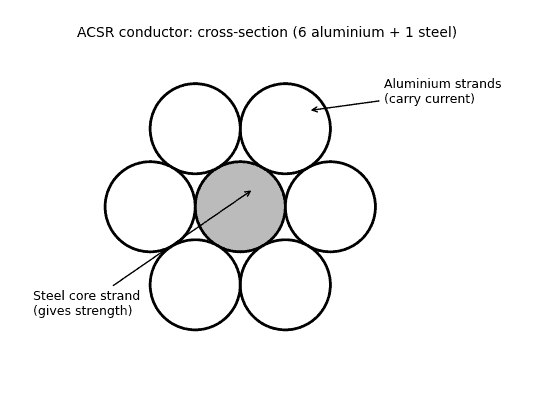 Fig. 1: Cross-section of an ACSR conductor (typical 6 aluminium + 1 steel arrangement)
Diagram in words: One grey circle (the steel strand) sits in the centre. Six white circles (the aluminium strands) are wound around it. The steel gives strength and the aluminium carries the current. Real conductors may use more strands, but the idea is the same.
Properties:
- High tensile strength and light weight.
- Good conductivity, as most of the current flows through the aluminium.
- Low cost compared with copper conductors.
- Can be used for long spans between towers.
Applications:
- Overhead transmission lines
- Overhead distribution lines
Exam tip: The full form of ACSR was asked as a one-mark question in two papers. Write it exactly: Aluminium Conductor Steel Reinforced.
8. Brass and Bronze
Brass and bronze are alloys of copper. An alloy is a mixture of two or more metals. Adding another metal makes copper harder and stronger, but lowers its conductivity.
| Basis | Brass | Bronze |
|---|---|---|
| Composition | Copper and zinc (generally about 60–70% copper) | Copper and tin (generally about 90% copper) |
| Properties | Harder than copper, easy to cast and machine, good corrosion resistance, lower conductivity | Harder and stronger than brass, good wear and corrosion resistance, lower conductivity |
| Applications | Plugs, sockets, terminals, lamp holders, switch parts, nuts and bolts | Springs, clamps, contacts, bearings and other parts that wear |
Exam tip: "Brass is an alloy of ___ and ___" or "Bronze is an alloy of ___" has been asked in three papers. Brass = copper + zinc. Bronze = copper + tin.
Important point: The brushes of DC machines and slip-ring motors are generally made of carbon (graphite), not bronze.
9. Quick Comparison of Main Low Resistivity Materials
| Material | Main advantage | Main limitation | Typical use |
|---|---|---|---|
| Silver | Best conductivity | Very costly, tarnishes | Contacts |
| Gold | Does not corrode | Very costly, soft | Contacts in electronics |
| Copper | High conductivity and strength | Costlier and heavier than aluminium | Wires, windings |
| Aluminium | Light and cheap | Lower strength, hard to solder | Overhead lines |
| Steel | Very strong | High resistivity, rusts | Earth wire, ACSR core |
| ACSR | Strong and light | Not for indoor wiring | Transmission lines |
| Brass, bronze | Hard, corrosion resistant | Lower conductivity | Terminals, springs |
Everyday Examples to Remember
- House wiring and the winding of a ceiling fan: copper.
- Thick wires on the big towers: ACSR.
- Pins of a plug and the terminals of a switch: brass.
- Gold-coloured pins on a computer memory card: gold plating.
MCQ and True/False Facts
- Copper is the most used conducting material. Aluminium is the second.
- Silver is the best conductor, but it is too costly for general use.
- ACSR means Aluminium Conductor Steel Reinforced.
- Brass is an alloy of copper and zinc. Bronze is an alloy of copper and tin.
- The commutator of a DC motor is made of copper (hard drawn copper).
- Brushes of DC machines and slip-ring motors are made of carbon, not bronze or copper.
- Ductility is the property of being drawn into wires.
Important Questions for Examinations
Short Answer Questions
- Write the properties and applications of copper.
- Make a comparison between hard drawn copper and annealed copper.
- Write the applications of silver, gold and platinum in the electrical engineering field.
- Write short notes on aluminium and steel as conducting materials.
- What is ACSR? Write its full form, construction and uses.
- Write short notes on brass and bronze (composition, properties and uses).
Long Answer Question
- Discuss low resistivity conducting materials with their properties and applications.
Quick Revision
- Low resistivity materials carry current with minimum loss.
- Silver is the best conductor; gold does not corrode. Both are costly and used for contacts.
- Copper is the most used. Hard drawn copper is strong. Annealed copper is soft and flexible.
- Aluminium is light and cheap, with about 60% of the conductivity of copper.
- Steel gives strength. ACSR = aluminium wires over a steel core, used in overhead lines.
- Brass = copper + zinc. Bronze = copper + tin.
Related Topics to Study Next
Before this note: Classification of Electrical Engineering Materials. Also see: Conducting Materials: Low and High Resistivity Materials. Next: High Resistivity Materials; Germanium and Silicon.
Conclusion
Low resistivity materials are chosen for the job: silver and gold for special contacts, copper for wires and windings, aluminium and ACSR for long overhead lines, steel for strength, and brass and bronze for hard parts such as terminals and springs. Knowing the main advantage and limitation of each material helps you choose correctly and answer any exam question on this topic.
More notes in Electrical Engineering Materials
- Soft Magnetic Materials: Silicon Steel, C.R.G.O., Nickel-Iron, Mu Metal and Soft Ferrites
- Hysteresis Loss, Eddy Current Loss and Properties of Good Magnetic Materials
- Mica, Asbestos, Ceramics, Glass and Other Solid Insulating Materials
- Plastics as Insulating Materials: PVC, Bakelite, Epoxy Resin, Melamine, Teflon and Others
- Gaseous and Liquid Insulating Materials: Air, Nitrogen, SF6, Mineral Oil and Pyranol
- Insulating Materials: Properties and Classification
Comments (0)
Sign in or create an account to leave a comment.
No comments yet.