Hard Magnetic Materials: Tungsten Steel, Chromium Steel, Cobalt Steel, Alnico and Hard Ferrites
Ch. Devi Lal Government Polytechnic, Nathusari Chopta › Diploma in Engineering (Polytechnic) › Electrical Engineering › Semester 3
Hard Magnetic Materials: Tungsten Steel, Chromium Steel, Cobalt Steel, Alnico and Hard Ferrites
A fridge door magnet, a loudspeaker magnet and the magnet of a small DC motor are all permanent magnets. They keep their magnetism without any current. They are made from hard magnetic materials.
In this note you will study the common hard magnetic materials and their uses. Before this note, read Magnetic Materials: Types, Properties, Hysteresis and Core Losses.
1. What Are Hard Magnetic Materials?
Definition: Hard magnetic materials are ferromagnetic materials which are difficult to magnetise and difficult to demagnetise. Once magnetised, they keep their magnetism for a very long time. They are used for making permanent magnets.
Properties:
- High retentivity: they keep a strong magnetic field after the magnetising force is removed.
- High coercivity: a strong reverse field is needed to demagnetise them.
- Wide hysteresis loop with a large area. They are not used for AC cores because their hysteresis loss is large.
- High energy product: they give a strong magnetic field from a small volume.
- Stable magnetism: they are not easily demagnetised by heat, shocks or stray fields.
- Usually hard and brittle, made by hardening (quenching) or casting and sintering.
Exam tip: "Hard magnetic materials are used for making permanent magnets (True/False)" has been asked. The answer is True.
2. The Demagnetisation Curve
The part of the hysteresis loop in the second quadrant (between the retentivity point and the coercivity point) is called the demagnetisation curve. It shows how well a permanent magnet works.
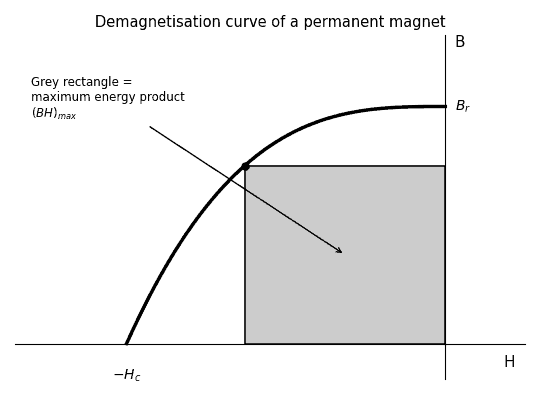 Fig. 1: Demagnetisation curve of a permanent magnet
Diagram in words: The curve starts on the B axis at the retentivity Br, and falls to the H axis at −Hc (the coercivity). A grey rectangle is drawn under the curve with its corner on the curve. The area of the biggest such rectangle is the maximum energy product (BH)max. A better permanent magnet material has a larger (BH)max.
3. Tungsten Steel
Composition: steel (iron with about 0.7% carbon) with about 5% to 6% tungsten (approximate).
Properties: good retentivity and fair coercivity, cheap, easy to harden by quenching. Its magnetism weakens gradually with time, heat and vibration, so it is now used only in a limited way.
Applications: older permanent magnets of instruments, magnetos and small motors, and simple magnets for toys and compass needles.
4. Chromium Steel
Composition: steel with about 3% to 6% chromium and about 1% carbon (approximate).
Properties:
- Good coercivity and good retentivity.
- Cheap and easy to harden by quenching in oil or water.
- Easily machined into shape before hardening.
- Its magnetic properties are less than those of cobalt steel.
Applications: permanent magnets of meters and measuring instruments, magnetos, and small motors.
Exam tip: "Write the properties of chromium steel" has been asked as a 4-mark short question.
5. Cobalt Steel
Composition: steel with a large amount of cobalt, generally about 15% to 35%, and small amounts of tungsten or chromium (approximate).
Properties:
- Higher coercivity and higher retentivity than tungsten and chromium steels.
- Higher energy product, so a smaller magnet gives the same field.
- More stable: it holds its magnetism better against heat, shocks and stray fields.
- Costlier than tungsten and chromium steel.
Applications: permanent magnets for motors, magnetos, loudspeakers, speedometers and good-quality instruments.
Exam tip: "Explain the properties of cobalt steel" has been asked as a 4-mark short question.
6. Alnico (Alcomax)
Alnico is an alloy of aluminium, nickel and cobalt, with iron and sometimes copper. Improved grades are sold under names such as Alcomax.
Properties:
- Very high retentivity and high coercivity.
- Very high energy product, much better than the steels above.
- Good stability even at higher temperatures.
- Very hard and brittle: it is made by casting or sintering and finished only by grinding.
- Costly, because of nickel and cobalt.
Applications: loudspeakers, microphones, DC motors and small generators, meters, magnetos, sensors and holding magnets.
Exam tip: Alnico is the permanent magnet material in an MCQ (options were Alnico, Mu-metal, copper and nickel iron). Alcomax is a hard material, not a soft one.
7. Hard Ferrites
Hard ferrites are ceramic materials, mainly barium ferrite and strontium ferrite. They are made by pressing iron oxide with barium or strontium oxide and heating (sintering).
Properties:
- High coercivity, so they resist demagnetisation very well.
- Moderate retentivity, lower than Alnico.
- Very high electrical resistivity, so there is no eddy current problem.
- Light in weight, cheap and do not rust.
- Hard and brittle.
Applications:
- Small DC motors and loudspeakers
- Fridge door magnets, toys and holding magnets
- Magnetic separators, sensors and microwave devices
Exam tip: "State the applications of hard ferrites" has been asked as a 4-mark short question.
8. Comparison of Hard Magnetic Materials
| Material | Main feature | Limitation | Typical use |
|---|---|---|---|
| Tungsten steel | Cheap, easy to harden | Magnetism weakens with time | Simple magnets, older instruments |
| Chromium steel | Cheap, easily machined | Moderate strength | Meters, magnetos |
| Cobalt steel | Higher coercivity and stability | Costly | Motors, loudspeakers |
| Alnico (Alcomax) | Very high energy product | Brittle, costly | Loudspeakers, motors, meters |
| Hard ferrites | High coercivity, cheap, light | Lower retentivity, brittle | Small motors, fridge magnets |
Note: The compositions and values in this note are approximate textbook values and are not given in the syllabus.
Everyday Examples to Remember
- The magnet strip in a fridge door: hard ferrite.
- The ring magnet behind a loudspeaker cone: ferrite or Alnico.
- The magnet inside a small toy motor: hard ferrite or steel magnet.
MCQ and True/False Facts
- Hard magnetic materials are used for making permanent magnets (True).
- Alnico is used for making permanent magnets.
- Tungsten steel and Alcomax are hard magnetic materials. Iron is soft.
- Hard ferrites are used in small motors, loudspeakers and fridge magnets.
- Hard magnetic materials have high retentivity and high coercivity.
Important Questions for Examinations
Short Answer Questions
- Explain the properties of cobalt steel.
- Write the properties of chromium steel.
- State the properties and applications of hard ferrites.
- Name any two hard magnetic materials. Write the properties of hard magnetic materials and the uses of permanent magnets.
- Write short notes on tungsten steel.
- Write short notes on Alnico (Alcomax).
Long Answer Question
- Discuss hard magnetic materials (tungsten steel, chromium steel, cobalt steel, Alnico and hard ferrites) with their properties and applications.
Quick Revision
- Hard materials: high retentivity, high coercivity, wide loop, for permanent magnets.
- Tungsten steel and chromium steel: cheap steel magnets.
- Cobalt steel: better and more stable, but costly.
- Alnico (Alcomax): very high energy product; brittle.
- Hard ferrites: ceramic, cheap, light, high coercivity; used in small motors and fridge magnets.
Related Topics to Study Next
Before this note: Magnetic Materials: Types, Properties, Hysteresis and Core Losses; Soft Magnetic Materials. Next unit: Unit V, Special Purpose Materials.
Conclusion
Hard magnetic materials hold their magnetism for a long time because of their high retentivity and coercivity. Steel magnets are cheap but weaker, cobalt steel and Alnico are stronger, and hard ferrites are cheap and light. Choose the material by the strength, stability and cost needed for the permanent magnet.
More notes in Electrical Engineering Materials
- Materials Used in the Fabrication of Motors and Generators: Part-wise Materials and Reasons
- Materials Used in the Fabrication of a Transformer: Part-wise Materials and Reasons
- Soldering, Bimetals and Fuses: Solder Materials, Bimetallic Strip and Fuse Wire
- Thermocouples: Principle, Working, Materials and Applications
- High Resistivity Materials: Constantan, Nichrome, Manganin, Tungsten, Carbon and Others
- Soft Magnetic Materials: Silicon Steel, C.R.G.O., Nickel-Iron, Mu Metal and Soft Ferrites
Comments (0)
Sign in or create an account to leave a comment.
No comments yet.