Materials Used in the Fabrication of Motors and Generators: Part-wise Materials and Reasons
Ch. Devi Lal Government Polytechnic, Nathusari Chopta › Diploma in Engineering (Polytechnic) › Electrical Engineering › Semester 3
Materials Used in the Fabrication of Motors and Generators: Part-wise Materials and Reasons
An electric motor has to carry current, carry magnetic flux, turn at high speed, bear heat and last for years. No single material can do all this, so each part is made from the best material for its job. The long answer "explain the various engineering materials for fabrication of a motor" (and "induction motor") has been asked in two of the four papers for 8 marks.
This note applies the knowledge of conductors, insulators and magnetic materials from the earlier units to motors and generators. Answer part by part: part name, material, reason.
1. Parts of a Three-Phase Induction Motor and Their Materials
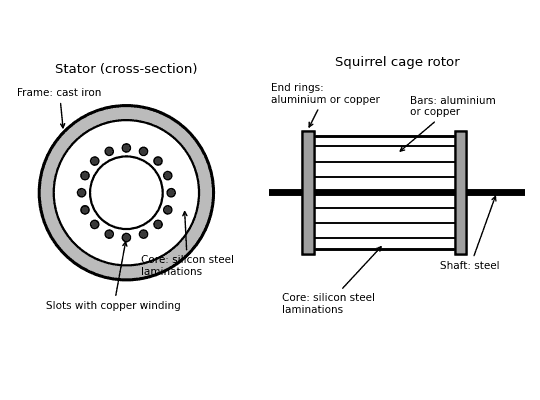 Fig. 1: Stator and squirrel cage rotor of an induction motor
Diagram in words: The left picture shows the stator as two rings. The outer thick ring is the frame. Inside it is the core with small round dots near its inner edge, which are the copper winding conductors in the slots. The right picture shows the rotor: a laminated cylinder with parallel bars along its length, a ring at each end joining all the bars, and a steel shaft through the centre.
2. Stator Frame (Yoke)
Material: cast iron (small and medium motors), welded mild steel (large motors), or aluminium alloy (small, light motors).
Reasons: strong enough to hold the core and bear the weight and torque; cast iron is cheap, is easily cast into shape with cooling fins and damps vibration; aluminium is light and conducts heat well.
3. Stator and Rotor Core
Material: silicon steel laminations (non-oriented, about 0.35 to 0.5 mm thick; approximate), with a thin insulating coating on each sheet, punched with slots.
Reasons:
- High permeability, so the flux is strong with a small magnetising current.
- Narrow hysteresis loop, so hysteresis loss is small.
- Silicon increases resistivity, and lamination breaks the paths of eddy currents. So eddy current loss is small. (A previous paper asked: laminating the stator core reduces eddy current losses.)
- The flux direction keeps changing in a rotating machine, so non-oriented steel is used rather than C.R.G.O.
4. Stator Winding
Material: copper wire (round or rectangular) with enamel insulation. Aluminium is used in some small or low-cost motors.
Reasons: low resistivity (low copper loss), ductile, strong, easy to wind and solder.
Insulation of the winding:
- Enamel on the wire (polyester or polyurethane).
- Slot liners and layer insulation: paper, presspaper, polyester film, mica or glass cloth.
- Slot wedges: Bakelite, epoxy-glass or bakelised wood.
- Impregnation: varnish or resin, applied by dipping and baking.
- Insulation class: Class B or F for most motors (see Insulating Materials: Properties and Classification).
5. Rotor Bars and End Rings (Squirrel Cage)
Material: aluminium (die-cast, for small and medium motors) or copper or brass (for large or high-efficiency motors).
Reasons: low resistivity, so the rotor current flows with little loss; aluminium is light, cheap and can be cast in one piece; copper has still lower resistivity and is used where high efficiency or strength is needed.
Slip-ring rotor: The rotor winding is of copper with insulation, like the stator winding.
6. Shaft, Bearings and End Shields
| Part | Material | Reason |
|---|---|---|
| Shaft | Carbon steel or alloy steel | High tensile strength and toughness; carries torque without bending or breaking |
| Bearings | Hardened chromium steel (ball or roller bearings); bronze or white metal in sleeve bearings | Hard, wear resistant and low friction |
| End shields (end covers) | Cast iron or aluminium alloy | Hold bearings accurately, strong, easily cast |
| Cooling fan | Aluminium, plastic or cast iron | Light and strong |
| Terminal box and terminals | Cast iron or aluminium box; Bakelite or porcelain block; brass or copper terminals | Strong, insulating and conducting where needed |
7. Slip Rings and Brushes (Slip-Ring Induction Motor)
Slip rings: brass, bronze or steel. They are smooth, hard and conduct well, and they are insulated from the shaft.
Brushes: carbon (graphite).
Reasons for carbon brushes:
- Soft and self-lubricating, so it does not wear down the slip ring or commutator.
- Good conductivity, and its resistance falls as it gets hot (negative temperature coefficient), which helps current sharing.
- It does not weld to the ring or commutator, and handles slight sparking.
- Cheap and easily replaced.
Brush holders and springs: brass holders, and springs of steel or phosphor bronze.
Exam tip: A previous paper asked "Brushes of 3-phase slip-ring induction motor are made up of ___". The answer is carbon.
8. Extra Parts of a DC Machine (Motor or Generator)
| Part | Material | Reason |
|---|---|---|
| Yoke (frame) | Cast steel (or cast iron for small machines) | Carries the magnetic flux and gives mechanical support; cast steel has higher permeability than cast iron |
| Field poles and pole shoes | Laminated silicon steel (or cast steel) | High permeability, low eddy loss |
| Field winding | Copper (enamelled) | Low resistivity |
| Armature core | Silicon steel laminations | Low hysteresis and eddy loss |
| Armature winding | Copper with Class B or F insulation | Low resistivity, strength |
| Commutator segments | Hard drawn copper | High conductivity, hard and wear resistant |
| Insulation between segments | Mica (micanite) | High dielectric strength, stands heat and arcing |
| Brushes | Carbon or graphite | Self-lubricating, good conductor |
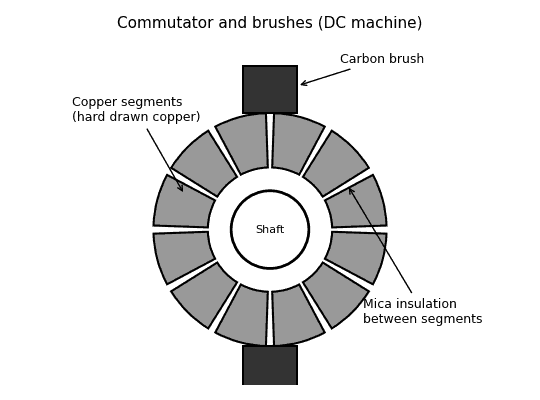 Fig. 2: Commutator and carbon brushes of a DC machine
Diagram in words: A ring is divided into many equal wedge-shaped copper segments. Narrow gaps between the segments are filled with mica. Two dark rectangles at the top and bottom are the carbon brushes, which press on the ring. A small circle in the centre is the shaft.
Exam tips: The commutator of a DC motor is made of copper (asked as a completion question). Brushes of a DC machine are made of carbon (or graphite). A statement that they are made of bronze is False.
9. Generators (Alternators)
The materials of generators are almost the same as those of motors.
- Stator core: silicon steel laminations. Stator winding: copper with mica or glass-epoxy insulation.
- Rotor (field): forged or cast steel (high-speed turbo type) or laminated steel poles. Field winding: copper, fed through slip rings.
- Slip rings and brushes: brass or steel rings with carbon brushes.
- Frame: welded steel or cast iron.
- Insulation: mica-based with epoxy or silicone resin (Class F or H) for large generators.
10. Complete Summary Table: Induction Motor
| Part | Material | Main reason |
|---|---|---|
| Stator frame | Cast iron or welded steel | Strong, cheap, damps vibration |
| Stator and rotor core | Silicon steel laminations | Low hysteresis and eddy loss |
| Stator winding | Copper (enamelled) | Low resistivity |
| Winding insulation | Enamel, paper, mica, varnish | Dielectric strength, heat resistance |
| Rotor bars and end rings | Aluminium (or copper) | Low resistivity, light, easy casting |
| Shaft | Carbon steel | Strength and toughness |
| Bearings | Hardened chromium steel | Wear resistance |
| Slip rings | Brass or bronze | Smooth, good conductor |
| Brushes | Carbon | Self-lubricating |
| End shields | Cast iron or aluminium | Strong, easy to cast |
Note: The choice of material changes with the size and type of machine. The thicknesses and details here are textbook values and are not given in the syllabus.
Everyday Examples to Remember
- The ribbed, heavy outer body of a pump motor: cast iron frame.
- The black carbon blocks you see when the end cover of a drill or mixer motor is opened: brushes.
- The gold-coloured copper commutator with narrow slits: copper segments with mica between.
MCQ and True/False Facts
- Brushes of a slip-ring induction motor are made of carbon.
- The commutator of a DC motor is made of copper.
- Brushes of a DC machine are not made of bronze (True/False answer: False).
- Laminating the stator core reduces eddy current losses.
- Squirrel cage rotor bars: aluminium or copper.
- Mica is used between the commutator segments.
Important Questions for Examinations
Short Answer Questions
- Write the material used for the stator and rotor core of an induction motor. Why is the core laminated?
- Write the materials used for the windings and winding insulation of a motor.
- Write the materials used for the rotor bars, end rings, shaft and bearings of an induction motor, with reasons.
- Write the materials used for brushes, slip rings and commutator, with reasons.
Long Answer Questions
- Explain the various engineering materials necessary for the fabrication of an induction motor.
- Explain the various engineering materials for the fabrication of a DC motor and generator.
Quick Revision
- Core: silicon steel laminations. Winding: copper. Insulation: enamel, paper, mica, varnish.
- Squirrel cage: aluminium or copper bars and end rings.
- Shaft: carbon steel. Bearings: hardened chromium steel. Frame: cast iron or steel.
- Brushes: carbon. Slip rings: brass or bronze. Commutator: copper with mica between segments.
- Generator materials are the same as those of motors.
Related Topics to Study Next
Before this note: Low Resistivity Materials; Soft Magnetic Materials; Plastics, Mica and Other Solid Insulators; Materials Used in the Fabrication of a Transformer. This is the last note of the subject.
Conclusion
Each part of a motor or generator uses the material best for its job: silicon steel for cores, copper for windings, aluminium or copper for rotor bars, steel for the shaft and frame, carbon for brushes and copper with mica for the commutator. In the exam, write each answer as part, material and reason.
More notes in Electrical Engineering Materials
- Hard Magnetic Materials: Tungsten Steel, Chromium Steel, Cobalt Steel, Alnico and Hard Ferrites
- Materials Used in the Fabrication of a Transformer: Part-wise Materials and Reasons
- Soldering, Bimetals and Fuses: Solder Materials, Bimetallic Strip and Fuse Wire
- Thermocouples: Principle, Working, Materials and Applications
- High Resistivity Materials: Constantan, Nichrome, Manganin, Tungsten, Carbon and Others
- Soft Magnetic Materials: Silicon Steel, C.R.G.O., Nickel-Iron, Mu Metal and Soft Ferrites
Comments (0)
Sign in or create an account to leave a comment.
No comments yet.