Plastics as Insulating Materials: PVC, Bakelite, Epoxy Resin, Melamine, Teflon and Others
Ch. Devi Lal Government Polytechnic, Nathusari Chopta › Diploma in Engineering (Polytechnic) › Electrical Engineering › Semester 3
Plastics as Insulating Materials: PVC, Bakelite, Epoxy Resin, Melamine, Teflon and Others
Switches, plugs, sockets, wire covers, pipes and the body of a fuse holder are all made of plastics. Plastics are cheap, light and easy to mould into any shape. Most important, they are good insulators. That is why they are the most widely used solid insulating materials.
In this note you will learn how plastics are divided into two groups and what each important plastic is used for. For the basic properties of insulators, see Insulating Materials: Properties and Classification. For gas and liquid insulators, read Gaseous and Liquid Insulating Materials.
1. What Are Plastics?
Definition: Plastics are man-made (synthetic) materials made of very long molecules called polymers. They can be moulded into the required shape using heat and pressure.
A polymer is like a very long chain made by joining thousands of small units. A plastic is a good insulator because it has no free electrons, so it has very high resistivity (see Classification of Electrical Engineering Materials).
Important point: Plastic is a bad conductor of electricity. This has been asked as an MCQ.
2. Classification of Plastics
On the basis of how they behave when heated, plastics are of two types.
2.1 Thermoplastic Materials
Definition: Thermoplastic materials are plastics that become soft on heating and hard again on cooling. This can be repeated many times.
Analogy: Wax or butter. You can melt it, shape it and let it set, and then melt it again.
Properties:
- Soften on heating and harden on cooling, without any permanent change.
- Long chain molecules with weak forces between the chains.
- Can be melted again and reused (recycled).
- Generally flexible and tough, but with lower heat resistance.
Examples: PVC, polyethylene, polystyrene, Teflon.
Applications: insulation of wires and cables, conduit pipes, casings, capacitor films.
2.2 Thermosetting Materials
Definition: Thermosetting materials are plastics that become permanently hard when they are heated and moulded once. After this they cannot be softened again.
Analogy: Baking a cake or frying an egg. Once cooked, heating it again will not make it soft. It will only burn.
Properties:
- Heating causes cross-links to form between the chains, which makes a rigid network.
- Cannot be melted again. On too much heating they char (burn).
- Hard, strong and brittle, with good heat resistance and dimensional stability.
- Cannot be recycled easily.
Examples: Bakelite, melamine, epoxy resin (after hardening), silicone resins.
Applications: switches, plug and socket bodies, switch boards, terminal blocks, laminates, parts used at higher temperature.
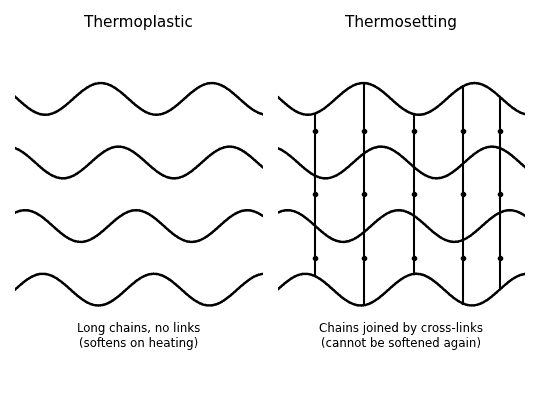 Fig. 1: Structure of thermoplastic and thermosetting materials
Diagram in words: The left picture shows four long wavy lines (chains) lying side by side with no connection between them. These can slide over each other when heated, so the material softens. The right picture shows the same wavy lines, but short vertical lines with dots join one chain to the next. These cross-links lock the chains in place, so the material cannot be softened again.
2.3 Comparison of Thermoplastic and Thermosetting Materials
| Basis | Thermoplastic | Thermosetting |
|---|---|---|
| Effect of heat | Softens again and again | Sets once, cannot be softened again |
| Structure | Long chains, no cross-links | Cross-linked network |
| Hardness | Softer, flexible | Hard and brittle |
| Heat resistance | Lower | Higher |
| Recycling | Possible | Difficult |
| Examples | PVC, polyethylene, polystyrene, Teflon | Bakelite, melamine, epoxy resin, silicone resin |
Exam tip: "Write a short note on thermoplastic materials" and "Explain in brief about the thermosetting material" have each been asked as 4-mark short questions.
3. PVC (Polyvinyl Chloride)
PVC is a thermoplastic. It is the most common cable insulation in the world. Exam tip: "Expand PVC" has been asked as a one-mark question: Polyvinyl Chloride.
Properties:
- Good electrical insulation and moisture resistance.
- Flexible when a plasticiser is added; hard (rigid) without it.
- Flame retardant: it does not support burning easily.
- Resists acids, alkalis and oils.
- Cheap. Its safe working temperature is not high (about 70 °C for normal cables; approximate), and it becomes brittle in extreme cold.
Applications: insulation and sheath of wires and cables, conduit pipes, insulating tapes, switch and socket parts.
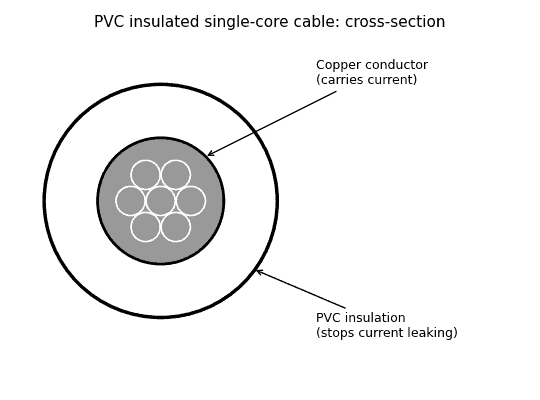 Fig. 2: Cross-section of a PVC insulated single-core cable
Diagram in words: A grey circle in the middle is the copper conductor, made of several thin strands. Around it is a thick ring of PVC insulation. The conductor carries the current and the PVC ring stops the current from leaking out. For copper and other cable conductors, see Low Resistivity Materials: Silver, Gold, Copper, Aluminium, Steel, ACSR, Brass and Bronze.
4. Polyethylene
Polyethylene is a thermoplastic made from ethylene gas.
Properties: excellent dielectric properties and very low dielectric loss, very low moisture absorption, light, flexible and tough, good chemical resistance. It softens at a fairly low temperature (about 100 °C; approximate), and the cross-linked type (XLPE) works at a higher temperature.
Applications: insulation of high-frequency and coaxial cables, telephone cables, power cables (XLPE), capacitor films.
5. Polystyrene
Polystyrene is a thermoplastic that is hard, clear and brittle.
Properties: very low dielectric loss at high frequency, low moisture absorption, good surface finish, easy to mould. It softens at a low temperature and cracks easily.
Applications: insulating parts of high-frequency equipment, coil formers, capacitors, casings of electronic items.
6. Bakelite
Bakelite is the first synthetic plastic. It is made from phenol and formaldehyde and is a thermosetting plastic.
Properties:
- Good electrical insulation and high dielectric strength.
- Hard, rigid and strong, but brittle.
- Does not soften on heating (heat resistant) and is a poor conductor of heat.
- Resists acids and moisture, but is attacked by strong alkalis.
- Easily moulded and cheap.
Uses:
- Switches, plugs, sockets and holders
- Switch boards, panels, terminal blocks and insulating sheets
- Handles of tools and parts of electrical appliances
Exam tip: "Write the properties of Bakelite and its two uses" has been asked as a 4-mark short question. It has also been asked together with SF6, which is covered in Gaseous and Liquid Insulating Materials.
7. Epoxy Resin
Epoxy resin is a liquid resin. When mixed with a hardener, it turns into a hard thermosetting solid.
Properties:
- Excellent electrical insulation and high dielectric strength.
- Very strong adhesion: it sticks well to metals and glass.
- Little shrinkage while hardening.
- Good mechanical strength.
- Resists moisture, chemicals and heat well.
Applications:
- Casting and encapsulation of dry-type transformers and electronic parts
- Insulators and bushings
- Base material of printed circuit boards (glass-epoxy laminates)
- Adhesives and varnishes
Exam tip: "Enlist the properties of insulating oil and epoxy resin" has been asked as a 4-mark short question. For insulating oil, see Gaseous and Liquid Insulating Materials.
8. Melamines
Melamine plastics are made from melamine and formaldehyde. They are thermosetting.
Properties: very hard and scratch resistant, good heat resistance, excellent resistance to arcing and tracking (it does not form a carbon path when sparks occur), good electrical properties, available in many colours.
Applications: moulded parts of switches and switchgear, arc-resistant insulation, decorative and electrical laminated sheets, impregnated cloth and paper.
Exam tip: Melamines were an option in an 8-mark long question ("write properties and applications of any two: solder, C.R.G.O., melamines").
9. Silicone Resins
Silicone resins are made from silicon, oxygen and carbon compounds. Most are thermosetting.
Properties: high heat resistance (suitable for Class H, 180 °C; see the temperature classes of insulation), water repellent, good dielectric properties that stay steady over a wide temperature range, flexible and long-lasting.
Applications: insulation of motors and transformers that run hot, varnishes, high-temperature cables, encapsulation of electronic parts.
10. Teflon (PTFE)
Teflon is the trade name of polytetrafluoroethylene (PTFE). It is a special plastic with fluorine in it. The syllabus lists it with natural insulators, but it is a synthetic plastic, so it is studied here.
Properties:
- Very high resistivity and very low dielectric loss, even at high frequency.
- Works at high temperature (up to about 250 °C; approximate).
- Almost every chemical leaves it unaffected.
- Water repellent, non-stick and non-flammable.
- Low friction, but weaker mechanically and more costly than most plastics.
Applications: insulation of high-temperature wires, coaxial cables, insulating bushes and spacers in high-frequency equipment, gaskets and non-stick coatings.
Exam tip: "Write any two properties of Teflon" has been asked as a one-mark question.
11. Summary Table of Plastics
| Plastic | Type | Main feature | Main use |
|---|---|---|---|
| PVC | Thermoplastic | Flexible, flame retardant, cheap | Wire and cable insulation |
| Polyethylene | Thermoplastic | Very low loss | Coaxial and power cables |
| Polystyrene | Thermoplastic | Low loss at high frequency, brittle | High-frequency parts |
| Teflon | Thermoplastic (special) | High temperature, chemical resistant | High-temperature wire |
| Bakelite | Thermosetting | Hard, heat resistant | Switches, sockets |
| Melamine | Thermosetting | Arc resistant, hard | Switchgear parts, laminates |
| Epoxy resin | Thermosetting | Strong adhesion, high strength | Casting, PCB, bushings |
| Silicone resin | Thermosetting | Very high heat resistance | Motor and transformer insulation |
Note: Temperature and other values are approximate textbook values and are not given in the syllabus.
Everyday Examples to Remember
- The cover on a house-wiring cable and the conduit pipe: PVC.
- The body of an old-style switch or plug top: Bakelite.
- The green circuit board in a mobile phone: glass-epoxy laminate.
- The non-stick coating on a pan: Teflon.
MCQ and True/False Facts
- PVC stands for polyvinyl chloride.
- Plastic is a bad conductor of electricity and heat.
- Bakelite and melamine are thermosetting plastics. PVC and polyethylene are thermoplastics.
- Thermoplastics soften on heating; thermosetting plastics do not.
- Epoxy resin is hardened using a hardener.
- Teflon works at high temperature and is chemically inert.
Important Questions for Examinations
Short Answer Questions
- Write a short note on thermoplastic materials.
- Explain in brief about the thermosetting material.
- Differentiate between thermoplastic and thermosetting materials.
- Write the properties of Bakelite and its two uses.
- Write the properties and applications of epoxy resin.
- Write any two properties of Teflon, and its uses.
- Write the properties and applications of PVC.
- Write short notes on polyethylene and polystyrene.
- Write the properties and applications of melamines and silicone resins.
Long Answer Question
- Explain plastics as insulating materials. Classify them and write the properties and applications of PVC, Bakelite, epoxy resin, melamine and Teflon.
Quick Revision
- Plastics are polymers moulded by heat and pressure and are good insulators.
- Thermoplastic: soft again and again on heating (PVC, polyethylene, polystyrene, Teflon).
- Thermosetting: set once and permanent (Bakelite, melamine, epoxy resin, silicone resin).
- PVC for cables; Bakelite for switches; epoxy for casting and PCB; melamine for arc-resistant parts; silicone for hot machines; Teflon for very high temperature.
Related Topics to Study Next
Before this note: Insulating Materials: Properties and Classification and Gaseous and Liquid Insulating Materials.
Related reading: Insulating Material: Properties, Importance and Examples and Dielectric Material, Dielectric Strength, Dielectric Loss and Loss Angle.
Next: Mica, Asbestos, Ceramics, Glass and Other Solid Insulators.
Conclusion
Plastics are the main solid insulators of modern electrical work. Thermoplastics such as PVC are flexible and used for cables. Thermosetting plastics such as Bakelite, melamine and epoxy are hard and heat resistant and used for switches, switchgear and casting. Silicone resins and Teflon are chosen when the temperature is very high.
More notes in Electrical Engineering Materials
- Soft Magnetic Materials: Silicon Steel, C.R.G.O., Nickel-Iron, Mu Metal and Soft Ferrites
- Hysteresis Loss, Eddy Current Loss and Properties of Good Magnetic Materials
- Mica, Asbestos, Ceramics, Glass and Other Solid Insulating Materials
- Gaseous and Liquid Insulating Materials: Air, Nitrogen, SF6, Mineral Oil and Pyranol
- Insulating Materials: Properties and Classification
- Germanium and Silicon: Semiconductor Materials and Their Applications
Comments (0)
Sign in or create an account to leave a comment.
No comments yet.