Soft Magnetic Materials: Silicon Steel, C.R.G.O., Nickel-Iron, Mu Metal and Soft Ferrites
Ch. Devi Lal Government Polytechnic, Nathusari Chopta › Diploma in Engineering (Polytechnic) › Electrical Engineering › Semester 3
Soft Magnetic Materials: Silicon Steel, C.R.G.O., Nickel-Iron, Mu Metal and Soft Ferrites
The core of a transformer must pick up magnetism and lose it again 50 times in every second, with as little waste as possible. Only a special group of materials can do this. They are called soft magnetic materials. They are "soft" in the magnetic sense: they are easy to magnetise and easy to demagnetise.
Before this note, read Hysteresis Loss, Eddy Current Loss and Properties of Good Magnetic Materials for core losses, and Magnetic Materials: Classifications, Types and Important Terms for permeability, coercivity and the hysteresis loop. These ideas are used here.
1. What Are Soft Magnetic Materials?
Definition: Soft magnetic materials are ferromagnetic or ferrimagnetic materials which can be magnetised and demagnetised very easily. They keep very little magnetism when the magnetising force is removed.
Main properties: high permeability, low coercivity and retentivity, and a narrow hysteresis loop, so losses are small. The full list of desirable properties is given in Hysteresis Loss, Eddy Current Loss and Properties of Good Magnetic Materials, and the comparison with hard materials is in Magnetic Materials: Classifications, Types and Important Terms.
Applications: cores of transformers, motors, generators, relays, chokes and electromagnets.
Exam tip: Soft iron (pure iron) is a soft magnetic material. A previous paper asked which of tungsten steel, bismuth, iron and Alcomax is soft. The answer is iron.
2. Iron-Silicon Alloy (Silicon Steel)
Composition: iron with a small amount of silicon, generally about 0.5% to 4% (approximate; transformer grades have about 3% to 4%).
Why silicon is added:
- It increases the electrical resistivity, so eddy current loss falls.
- It reduces hysteresis loss and improves permeability.
- It stops the ageing of iron, so losses do not increase with time.
Limit: If more silicon is added, the steel becomes brittle and hard to roll, and its saturation flux density falls a little. So the amount is kept limited.
Properties: high permeability, low hysteresis loss, high resistivity, low cost, supplied as thin laminations (about 0.35 to 0.5 mm) coated with insulation. Thin laminations are explained in the eddy current section of Hysteresis Loss, Eddy Current Loss and Properties of Good Magnetic Materials.
Applications: cores of transformers, stators and rotors of motors and generators, chokes and relays.
3. Grain Orientation and C.R.G.O.
Steel is made of tiny crystals called grains. In each grain, the magnetism is easiest along one particular direction (the easy direction). In ordinary steel the grains point in all directions, so the average behaviour is only moderate.
Grain orientation: In grain-oriented steel, the grains are lined up in one direction (the rolling direction). This is done by rolling the steel in the cold state and then giving it a special heat treatment. The steel then has very high permeability and very low loss when the flux flows along the rolling direction.
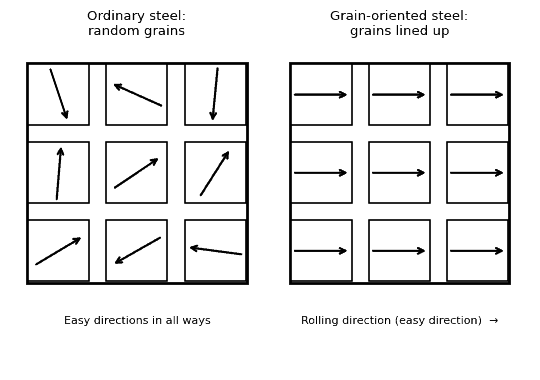 Fig. 1: Grain orientation in ordinary steel and in grain-oriented steel
Diagram in words: The left square is divided into nine small crystals. The arrow in each crystal shows its easy direction, and the arrows point in different directions. The right square also has nine crystals, but all the arrows point to the right, along the rolling direction. This is why grain-oriented steel magnetises so easily along that direction.
C.R.G.O. (Cold Rolled Grain Oriented) silicon steel:
- Very high permeability and very low hysteresis loss along the rolling direction.
- Thin laminations with an insulating coating, so eddy current loss is low.
- Smaller and lighter cores for the same rating, and lower no-load loss.
- More costly than ordinary silicon steel.
- Properties are poor across the rolling direction, and are spoilt by bending, cutting and stress (the sheets are annealed after cutting).
Applications: cores of power and distribution transformers.
Important point: C.R.G.O. is used where the flux always flows in one fixed direction, as in a transformer. In the stator and rotor of a rotating machine the flux direction keeps changing around the core, so C.R.G.O. is not suitable there. Non-oriented silicon steel is used instead. Therefore the statement "C.R.G.O. sheet is used for construction of cores of rotating electrical machines" is False.
Exam tip: C.R.G.O. was an option in an 8-mark long question ("write properties and applications of any two: solder, C.R.G.O., melamines") and in a True/False question.
4. Nickel-Iron Alloys
Composition: iron with a large amount of nickel (about 35% to 80%; approximate). Permalloy is a common name for this group.
Properties:
- Very high permeability, much higher than silicon steel.
- Very low coercivity and very low hysteresis loss.
- Lower saturation flux density (they saturate sooner).
- Costly, and their properties are spoilt by mechanical stress.
Applications: small audio and communication transformers, sensitive relays, magnetic amplifiers, magnetic shields, and cores for small signal circuits.
5. Mu Metal
Mu metal is a nickel-iron alloy with a very high nickel content (about 75% to 80%) and small amounts of copper and molybdenum (approximate). The name comes from μ, the symbol of permeability.
Properties:
- Extremely high permeability (relative permeability from tens of thousands up to about a lakh; approximate).
- Very low coercivity and very low hysteresis loss.
- Low saturation flux density, so it saturates easily in strong fields.
- Soft and costly. It must be annealed after it is shaped, and it is spoilt by shocks and bending.
Applications:
- Magnetic shielding of sensitive instruments, cathode ray tubes and cables
- Cores of audio and low-level signal transformers
- Magnetic recording heads and sensitive instruments
Exam tip: "Write properties of Mu metal" has been asked as a 4-mark short question.
6. Soft Ferrites
Ferrites are ceramic materials made from iron oxide mixed with oxides of other metals such as manganese, zinc or nickel. They are the ferrimagnetic materials described in Magnetic Materials: Classifications, Types and Important Terms. The powder is pressed and heated (sintered) into the required shape. Soft ferrites are of the manganese-zinc and nickel-zinc types.
Properties:
- Very high electrical resistivity, so eddy current loss is almost nil, even at high frequency.
- Low coercivity and low hysteresis loss.
- Moderate permeability and lower saturation flux density than steel.
- Hard and brittle, and they cannot take shocks. They are made only by moulding.
- Cheap in large numbers and light in weight.
Applications:
- Cores of high-frequency transformers (for example in SMPS and chargers)
- Inductors, chokes and filters in radio and TV
- Antenna rods of radios
- Recording heads and microwave devices
Exam tip: "Write a short note on soft ferrites and its uses" has been asked as a 4-mark short question. The MCQ "high-frequency transformer cores are generally made from ___" has the answer ferrites.
7. Comparison of Soft Magnetic Materials
| Material | Main advantage | Limitation | Typical use |
|---|---|---|---|
| Soft iron | High permeability, cheap | Low resistivity, high eddy loss in AC | Electromagnets, relays, DC poles |
| Silicon steel | High resistivity, low loss | Brittle if too much silicon | Motor and transformer cores |
| C.R.G.O. | Very low loss along rolling direction | Poor across grain, costly | Power transformer cores |
| Nickel-iron | Very high permeability | Costly, low saturation | Small signal transformers |
| Mu metal | Highest permeability | Costly, easily saturated | Magnetic shielding |
| Soft ferrites | Very high resistivity | Brittle, low saturation | High-frequency cores |
Note: The compositions and values in this note are approximate textbook values and are not given in the syllabus.
Everyday Examples to Remember
- The big transformer on a pole or in a substation: C.R.G.O. core.
- The core inside a ceiling fan motor or an induction motor: silicon steel laminations.
- The small black core inside a mobile charger: soft ferrite.
- The metal can that shields a sensitive instrument from stray magnetism: Mu metal.
MCQ and True/False Facts
- Soft magnetic material: iron (and silicon steel, Mu metal, soft ferrites). Tungsten steel and Alcomax are hard magnetic materials.
- High-frequency transformer cores are made from ferrites.
- C.R.G.O. is used in transformer cores, not in cores of rotating machines (the statement for rotating machines is False).
- Mu metal has very high permeability and is a nickel-iron alloy.
- Silicon is added to steel to increase its resistivity and reduce losses.
Important Questions for Examinations
Short Answer Questions
- Write a short note on soft ferrites and its uses.
- Write the properties of Mu metal and its applications.
- What is grain orientation? Write the properties and applications of C.R.G.O.
- Write the properties and applications of iron-silicon alloy. Why is silicon added?
- Write the properties and applications of nickel-iron alloy.
- Write the desirable properties of soft magnetic materials and name four soft magnetic materials with one use each.
Long Answer Question
- Discuss soft magnetic materials (iron-silicon alloy, C.R.G.O., nickel-iron alloy, Mu metal and soft ferrites) with their properties and applications.
Quick Revision
- Soft materials: easy to magnetise and demagnetise, narrow loop, low loss.
- Silicon steel: silicon raises resistivity, reduces eddy and hysteresis loss.
- C.R.G.O.: grains lined up in rolling direction; for transformer cores only.
- Nickel-iron and Mu metal: very high permeability; used for small transformers and shielding.
- Soft ferrites: very high resistivity; used for high-frequency cores.
Related Topics to Study Next
Before this note: Hysteresis Loss, Eddy Current Loss and Properties of Good Magnetic Materials and Magnetic Materials: Classifications, Types and Important Terms.
Next: Hard Magnetic Materials. Later: Materials for Transformers and Motors (Unit V).
Conclusion
Soft magnetic materials are chosen for the job: C.R.G.O. and silicon steel for power-frequency cores, nickel-iron and Mu metal where very high permeability or shielding is needed, and ferrites where the frequency is high. Remember each material by its main advantage, and you can answer both the short and the long question.
More notes in Electrical Engineering Materials
- Hysteresis Loss, Eddy Current Loss and Properties of Good Magnetic Materials
- Mica, Asbestos, Ceramics, Glass and Other Solid Insulating Materials
- Plastics as Insulating Materials: PVC, Bakelite, Epoxy Resin, Melamine, Teflon and Others
- Gaseous and Liquid Insulating Materials: Air, Nitrogen, SF6, Mineral Oil and Pyranol
- Insulating Materials: Properties and Classification
- Germanium and Silicon: Semiconductor Materials and Their Applications
Comments (0)
Sign in or create an account to leave a comment.
No comments yet.