Hysteresis Loss, Eddy Current Loss and Properties of Good Magnetic Materials
Ch. Devi Lal Government Polytechnic, Nathusari Chopta › Diploma in Engineering (Polytechnic) › Electrical Engineering › Semester 3
Hysteresis Loss, Eddy Current Loss and Properties of Good Magnetic Materials
In a transformer the core is magnetised and demagnetised 50 times every second. Every time, a little energy is wasted as heat. These wasted amounts are called core losses, and they decide which material is good for a core and which is not.
This note continues from Magnetic Materials: Classifications, Types and Important Terms. That note explains the basic terms (B, H, permeability), the types of magnetic materials, the hysteresis loop with retentivity and coercivity, and the comparison of soft and hard materials. Here we study the desirable properties of good magnetic materials, hysteresis loss and eddy current loss, and the extra Curie temperature values.
Magnetic materials are one of the four groups of electrical engineering materials. For the full picture, see Classification of Electrical Engineering Materials.
1. Desirable Properties of Good Magnetic Materials
The two main jobs of magnetic materials need different properties. A core must change its magnetism easily. A permanent magnet must keep its magnetism.
For cores of transformers, motors and relays (soft materials):
- High permeability, so that a strong flux is produced by a small current.
- Low retentivity and low coercivity, so that it magnetises and demagnetises easily.
- Narrow hysteresis loop, so that hysteresis loss is small.
- High electrical resistivity, so that eddy current loss is small.
- High saturation flux density.
- Good mechanical strength and easy to roll into thin sheets.
For permanent magnets (hard materials):
- High retentivity (strong magnetism is left behind).
- High coercivity (it is difficult to demagnetise).
- Wide hysteresis loop and high energy product.
- Stable magnetism with time, temperature and vibration.
Exam tip: "List the desirable properties of good magnetic materials" has been asked as a 4-mark short question. Give 5 or 6 points.
2. Hysteresis Loss
Definition: Hysteresis loss is the energy lost as heat in a magnetic material when it is magnetised and demagnetised again and again (the magnetisation is reversed in every cycle). The energy lost per cycle is proportional to the area of the hysteresis loop. To see the loop and its terms, refer to the hysteresis loop section of Magnetic Materials: Classifications, Types and Important Terms.
Why it occurs: The tiny magnetic domains in the material have to turn against internal friction every time the field reverses. The work done in turning them becomes heat.
Steinmetz formula (approximate): hysteresis loss = η × Bmax1.6 × f × V watts, where η is the Steinmetz coefficient of the material, Bmax is the maximum flux density, f is the frequency and V is the volume of the core.
Factors on which hysteresis loss depends:
- Maximum flux density (Bmax): more flux density gives more loss.
- Frequency (f): loss is directly proportional to the frequency.
- Volume of the core: a bigger core has more loss.
- Quality of the material: a material with a wide loop (large Steinmetz coefficient) has more loss than a soft material with a narrow loop.
How to reduce it: use soft materials such as silicon steel, C.R.G.O. or ferrites, which have narrow loops, and keep Bmax within limits.
Exam tip: "Define hysteresis losses and discuss the factors on which hysteresis loss depends" has been asked in two papers. It is a must-prepare 4-mark question.
3. Eddy Current Loss
When the flux in a core changes, voltage is induced in the core itself. This voltage drives small circulating currents inside the core, called eddy currents. They produce heat, which is a waste of energy.
Eddy current loss (approximate): proportional to Bmax2 × f2 × t2 × V, where t is the thickness of the sheet. It also decreases as the resistivity of the core increases.
How to reduce it:
- Lamination: make the core from thin sheets (laminations), insulated from each other by varnish (see insulating varnishes and enamels) or an oxide coating. This breaks the path of the eddy currents.
- Add silicon: silicon in steel raises its resistivity.
- Use ferrites at high frequency: ferrites have extremely high resistivity.
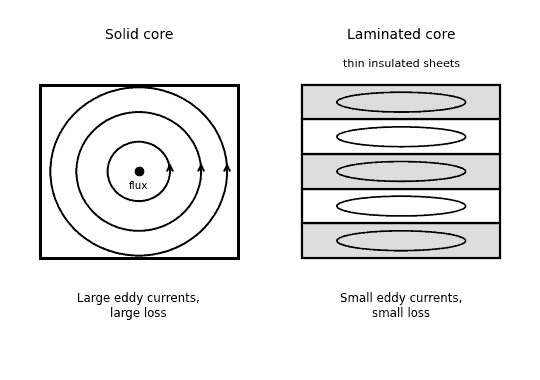 Fig. 1: Eddy currents in a solid core and in a laminated core
Diagram in words: The left picture shows a solid block of iron. Large circles inside it show big eddy currents. The right picture shows a block made of thin insulated strips. Each strip has only a small flat loop, so the total eddy current and loss are much smaller.
Exam tip: A previous paper asked which loss is reduced by laminating the stator core of a three-phase induction motor. The answer is eddy current loss, not hysteresis loss.
4. Curie Temperature Values
The definition of Curie temperature is given in Magnetic Materials: Classifications, Types and Important Terms. In short, a ferromagnetic material loses its magnetic properties above it and behaves like a paramagnetic material.
Approximate values: iron about 770 °C, nickel about 360 °C, cobalt about 1115 °C. These are textbook values and are not given in the syllabus.
Exam tip: A previous paper asked "The magnetic material loses its magnetic properties at ___". The answer is Curie temperature.
Everyday Examples to Remember
- The core of a transformer or of a ceiling fan motor: soft material in thin laminations, to keep eddy current and hysteresis loss low.
- The magnet of a loudspeaker or fridge door: hard material, chosen for high retentivity and coercivity.
MCQ and True/False Facts
- Laminating the stator core reduces eddy current losses.
- The area of the hysteresis loop represents the energy lost per cycle.
- Soft magnetic materials have a narrow hysteresis loop and low hysteresis loss.
- A magnetic material loses its magnetic properties at the Curie temperature.
- Hysteresis loss is directly proportional to frequency.
Important Questions for Examinations
Short Answer Questions
- List the desirable properties of good magnetic materials.
- Define hysteresis losses and discuss the factors on which hysteresis loss depends.
- What is eddy current loss? How is it reduced?
- Why is the core of a transformer or motor made of thin laminations?
Long Answer Question
- Discuss hysteresis loss and eddy current loss in a magnetic core, and explain the methods of reducing them.
Questions on the types of magnetic materials, the hysteresis loop, retentivity, coercivity, Curie temperature, and soft versus hard materials are answered in Magnetic Materials: Classifications, Types and Important Terms.
Quick Revision
- Soft core materials need high permeability, a narrow loop and high resistivity. Permanent magnets need high retentivity and coercivity.
- Hysteresis loss ∝ loop area; depends on Bmax, frequency, volume and material. Reduce it with soft materials such as silicon steel and ferrites.
- Eddy current loss: reduced by lamination, silicon and ferrites.
- Curie temperature: iron about 770 °C, nickel about 360 °C, cobalt about 1115 °C.
Related Topics to Study Next
Before this note: Magnetic Materials: Classifications, Types and Important Terms.
Next: Soft Magnetic Materials; Hard Magnetic Materials. Later: Materials for Transformers and Motors (Unit V).
Conclusion
Hysteresis loss and eddy current loss are the two core losses, and each has a simple remedy. A narrow hysteresis loop and soft material reduce hysteresis loss. Thin insulated laminations, silicon in steel and ferrites reduce eddy current loss. This is why cores that are magnetised again and again are made of soft, high-resistivity material.
More notes in Electrical Engineering Materials
- Soft Magnetic Materials: Silicon Steel, C.R.G.O., Nickel-Iron, Mu Metal and Soft Ferrites
- Mica, Asbestos, Ceramics, Glass and Other Solid Insulating Materials
- Plastics as Insulating Materials: PVC, Bakelite, Epoxy Resin, Melamine, Teflon and Others
- Gaseous and Liquid Insulating Materials: Air, Nitrogen, SF6, Mineral Oil and Pyranol
- Insulating Materials: Properties and Classification
- Germanium and Silicon: Semiconductor Materials and Their Applications
Comments (0)
Sign in or create an account to leave a comment.
No comments yet.