Germanium and Silicon: Semiconductor Materials and Their Applications
Ch. Devi Lal Government Polytechnic, Nathusari Chopta › Diploma in Engineering (Polytechnic) › Electrical Engineering › Semester 3
Germanium and Silicon: Semiconductor Materials and Their Applications
The mobile phone in your hand, the LED bulb in your room and the solar panel on a roof all depend on semiconductors. Almost all of them are made from one of two materials: silicon or germanium.
This is a short note. The basic ideas (doping, intrinsic and extrinsic, P-type and N-type) are explained in detail in Semiconductor Fundamentals. Here we cover the definition, applications and the properties of germanium and silicon.
1. What Is a Semiconductor?
Definition: A semiconductor is a material whose electrical conductivity lies between that of a conductor and an insulator.
In terms of energy bands, a semiconductor has a small forbidden gap between the valence band and the conduction band. At very low temperature the valence band is almost full and the conduction band is almost empty. At room temperature, some electrons jump the gap and the material conducts a little. See Classification of Electrical Engineering Materials for the energy band diagrams.
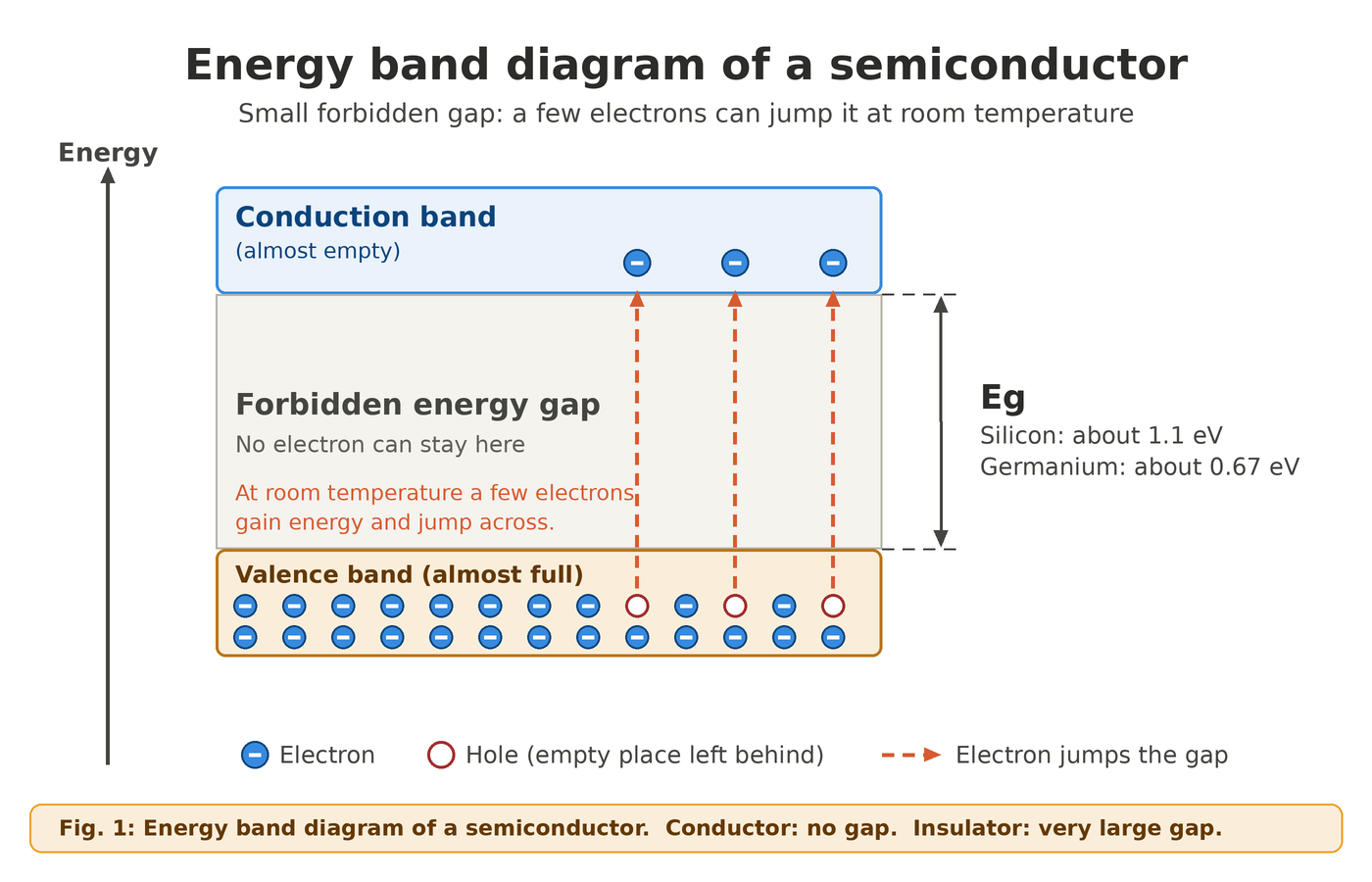 Fig. 1: Energy band diagram of a semiconductor
Diagram in words: The valence band is at the bottom and the conduction band is above it. Between them is a small forbidden gap. At room temperature a few electrons gain enough energy to cross this gap.
Important point: The resistance of a semiconductor decreases as its temperature rises. This is the opposite of metals. It also has a negative temperature coefficient of resistance, like carbon.
Exam tip: "Define semiconductor. Mention any four applications" has been asked in two papers. It is a very likely 4-mark question.
2. Commonly Used Semiconductor Materials
Germanium (Ge) and silicon (Si) are the two most commonly used semiconductor materials. Both have four valence electrons and form a crystal in which each atom shares one electron with each of its four neighbours (covalent bonds).
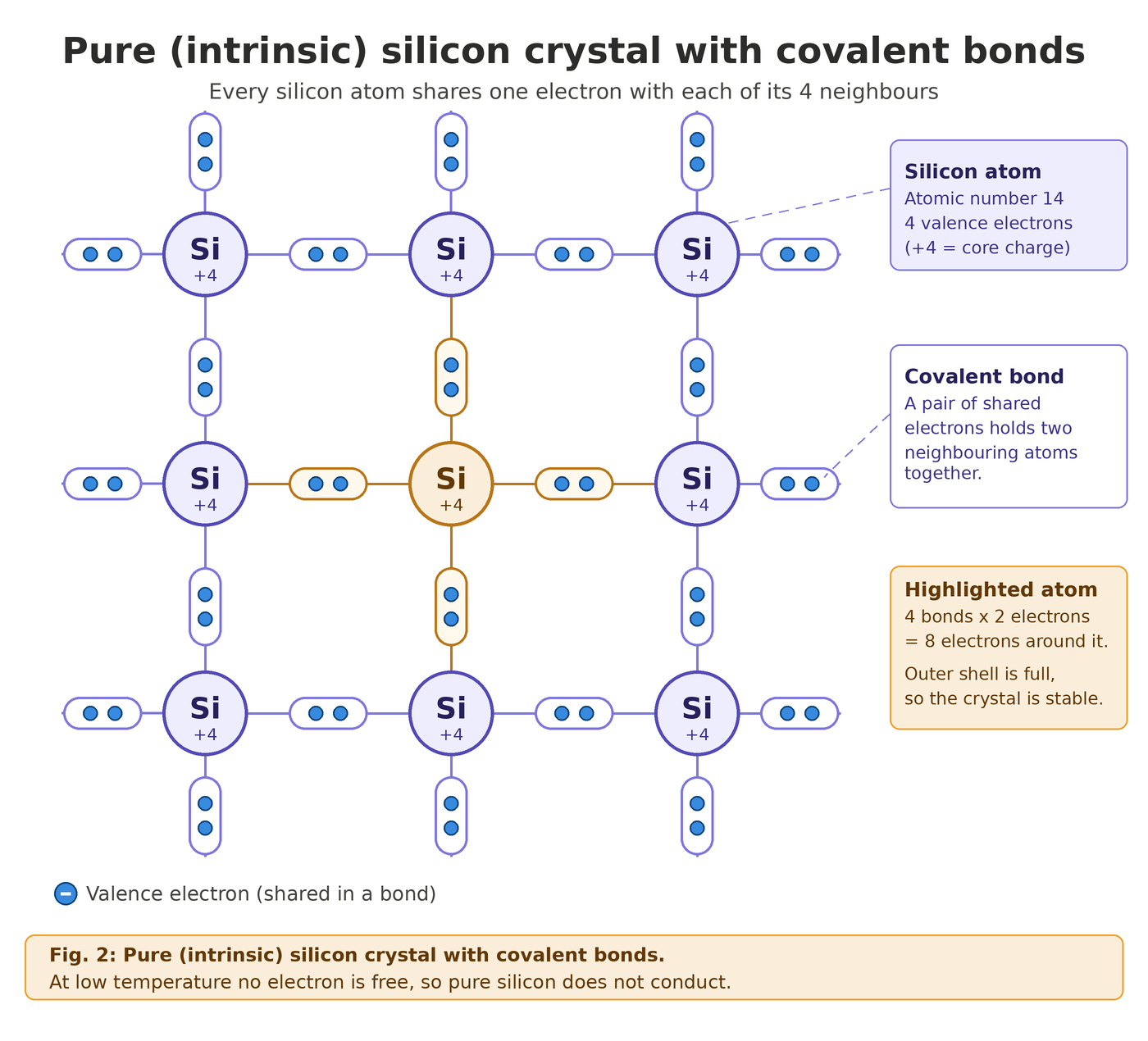 Fig. 2: Pure (intrinsic) silicon crystal with covalent bonds
Diagram in words: Each silicon atom is joined to four neighbouring atoms by shared pairs of electrons called covalent bonds. In pure silicon at low temperature no electron is free, so it does not conduct.
Besides Ge and Si, some compounds such as gallium arsenide are also used as semiconductors, mainly in special devices like LEDs and high-frequency devices.
3. Properties of Germanium and Silicon
| Basis | Germanium (Ge) | Silicon (Si) |
|---|---|---|
| Atomic number | 32 | 14 |
| Valence electrons | 4 | 4 |
| Forbidden energy gap (at room temperature) | About 0.67 eV | About 1.1 eV |
| Melting point | Lower (about 940 °C) | Higher (about 1410 °C) |
| Effect of temperature | More affected, since the gap is smaller; more leakage current | Less affected; leakage current is small |
| Safe working temperature | Lower (about 75 °C) | Higher (about 150 °C) |
| Voltage drop of a forward biased diode | About 0.3 V | About 0.7 V |
| Availability | Rare and costly | Very plentiful (sand) and cheap |
| Use today | Limited and special uses | Most widely used |
Note: The values above are approximate textbook values and are not given in the syllabus.
4. Why Is Silicon Preferred Over Germanium?
- Silicon works safely at higher temperature.
- Its leakage current is much smaller.
- It is very plentiful and therefore cheaper.
- It forms a strong and stable oxide layer (silicon dioxide), which makes it easy to build integrated circuits.
5. Types of Semiconductor
| Type | Meaning | Example |
|---|---|---|
| Intrinsic | Pure semiconductor with no impurity added | Pure silicon, pure germanium |
| Extrinsic | Semiconductor to which a small amount of impurity is added (doping) to improve conduction | N-type and P-type semiconductors |
Doping with a pentavalent impurity (such as phosphorus) gives an N-type semiconductor. Doping with a trivalent impurity (such as boron) gives a P-type semiconductor. Details and comparison tables are given in Semiconductor Fundamentals.
6. Applications of Semiconductors
- Diodes: rectifiers that change AC to DC, as in mobile chargers
- Transistors: amplifiers and electronic switches
- Integrated circuits (ICs): computers, mobile phones, TVs and microcontrollers
- Thyristors (SCR, TRIAC): control of motor speed, light dimming and fan regulators
- Solar cells: conversion of sunlight into electricity
- LEDs and photodiodes: lighting, displays and remote-control sensors
- Thermistors and sensors: temperature and light measurement
Everyday Examples to Remember
- The chip inside a mobile phone and the solar panel on a roof: silicon.
- The LED bulb in your home: a semiconductor device.
- A fan regulator with a smooth speed knob: a semiconductor device (TRIAC).
MCQ and True/False Facts
- Semiconductors have an almost empty conduction band and an almost filled valence band.
- The forbidden gap is largest in insulators, small in semiconductors, and absent in conductors.
- Germanium and silicon each have four valence electrons.
- Doping is the process of adding a small amount of impurity to a pure semiconductor.
- The conductivity of a semiconductor increases when temperature rises.
Important Questions for Examinations
Short Answer Questions
- Define semiconductor. Mention any four applications of semiconductors (discuss its engineering applications).
- Write the properties of germanium and silicon. Compare them.
- Why is silicon preferred to germanium for making semiconductor devices?
- What are the types of semiconductor? Differentiate between intrinsic and extrinsic semiconductors.
Quick Revision
- Semiconductor: conductivity between conductor and insulator; small forbidden gap.
- Ge: 32 electrons, gap about 0.67 eV. Si: 14 electrons, gap about 1.1 eV. Both have 4 valence electrons.
- Silicon is preferred: higher temperature limit, less leakage, cheap and plentiful.
- Types: intrinsic (pure) and extrinsic (doped: N-type and P-type).
- Applications: diodes, transistors, ICs, thyristors, solar cells, LEDs, sensors.
Related Topics to Study Next
Before this note: Semiconductor Fundamentals. Next unit: Unit III, Insulating Materials.
Conclusion
Germanium and silicon are the main semiconductor materials. Silicon is used far more because it works at higher temperature, leaks less current and is cheap. Semiconductors are the base of every modern electronic device and of the thyristor control circuits studied later in this course.
More notes in Electrical Engineering Materials
- Soft Magnetic Materials: Silicon Steel, C.R.G.O., Nickel-Iron, Mu Metal and Soft Ferrites
- Hysteresis Loss, Eddy Current Loss and Properties of Good Magnetic Materials
- Mica, Asbestos, Ceramics, Glass and Other Solid Insulating Materials
- Plastics as Insulating Materials: PVC, Bakelite, Epoxy Resin, Melamine, Teflon and Others
- Gaseous and Liquid Insulating Materials: Air, Nitrogen, SF6, Mineral Oil and Pyranol
- Insulating Materials: Properties and Classification
Comments (0)
Sign in or create an account to leave a comment.
No comments yet.