High Resistivity Materials: Constantan, Nichrome, Manganin, Tungsten, Carbon and Others
Ch. Devi Lal Government Polytechnic, Nathusari Chopta › Diploma in Engineering (Polytechnic) › Electrical Engineering › Semester 3
High Resistivity Materials: Constantan, Nichrome, Manganin, Tungsten, Carbon and Others
The coil of an electric heater glows red, a bulb filament shines white, and a resistance box keeps its value steady for years. None of this is possible with copper. These jobs need materials that resist current. They are the high resistivity materials.
This note explains the common high resistivity materials, what makes each one special, and where it is used.
1. What Are High Resistivity Materials?
Definition: High resistivity materials are conducting materials which offer large opposition to the flow of current. When current passes through them, much electrical energy changes into heat.
Examples: carbon, tungsten, platinum, mercury, lead, and alloys such as constantan (eureka), nichrome, manganin, phosphor bronze and tin-lead alloy.
Properties needed in a good high resistivity material:
- High resistivity, so that a short length gives the required resistance.
- Low (or zero) temperature coefficient of resistance, so that the value stays steady as it heats. This is needed for measuring instruments.
- High melting point, so that it can work at high temperature. This is needed for heating elements.
- Good resistance to oxidation, so that it does not burn away in air.
- Ductility, so that it can be drawn into thin wires.
Important point: Not every material has all these properties. Each material is chosen for the one or two that matter most for the job. All resistivity values in this note are approximate textbook values and are not given in the syllabus.
For the general idea of resistivity and temperature coefficient, see the note on Conducting Materials: Low and High Resistivity Materials.
2. Constantan (Eureka)
Composition: an alloy of copper (about 55–60%) and nickel (about 40–45%).
Properties:
- High resistivity (about 4.9 × 10⁻⁷ Ω·m).
- Very low temperature coefficient of resistance, so its resistance stays almost constant as temperature changes.
- Good ductility, so it can be drawn into fine wire.
- Gives a high thermoelectric voltage when joined with copper or iron.
Applications:
- Rheostats, potentiometers and resistance boxes
- Heating elements for low-temperature heating
- Thermocouples (copper-constantan, iron-constantan)
Exam tip: "Write the properties and applications of constantan" has been asked as a 4-mark short question.
3. Manganin
Composition: an alloy of copper (about 84%), manganese (about 12%) and nickel (about 4%).
Properties:
- High resistivity (about 4.8 × 10⁻⁷ Ω·m).
- Zero (almost zero) temperature coefficient of resistance.
- Its resistance stays stable for many years.
Applications:
- Standard resistances and resistance boxes
- Shunts of ammeters
- Precision electrical measuring instruments
Exam tip: A previous paper asked: "The material which has zero temperature coefficient of resistance is ___" (answer: manganin).
4. Nichrome
Composition: an alloy of nickel (about 80%) and chromium (about 20%). Some grades also contain iron.
Properties:
- Very high resistivity (about 1.1 × 10⁻⁶ Ω·m).
- High melting point (about 1400 °C).
- Does not oxidise easily when red hot, because a thin chromium oxide layer protects the wire.
- Good ductility, so it can be drawn into wires and ribbons.
Applications:
- Heating elements of electric heaters, irons, toasters and furnaces
- Starter coils of DC motors
- Rheostats
Exam tip: A previous paper asked which material is used for winding the coils of DC motor starters (answer: nichrome).
5. Tungsten
Properties:
- Highest melting point of all metals (about 3400 °C).
- Resistivity about 5.6 × 10⁻⁸ Ω·m, so it is higher than copper. It is placed in this group mainly for its high melting point.
- Very hard and strong at high temperature.
- Brittle at normal temperature, but can be drawn into very thin wire by special methods.
- Burns away quickly in air at high temperature, so it must work in vacuum or inert gas.
Applications:
- Filaments of incandescent lamps (sealed in glass bulbs filled with inert gas)
- Electrical contacts that face sparking and arcing
- Heating elements of vacuum furnaces
- Electrodes and parts in X-ray tubes and electronic valves
Exam tip: "State the important properties and application of tungsten" has been asked as a 4-mark short question.
6. Carbon
Carbon (graphite) is a non-metal that conducts electricity.
Properties:
- High resistivity compared with copper.
- Negative temperature coefficient of resistance: its resistance decreases as temperature rises.
- Very high melting (sublimation) point.
- Soft and slippery, so it acts as a lubricant.
- Cheap and does not melt or weld to the commutator.
Applications:
- Brushes of DC machines and slip-ring induction motors
- Carbon resistors in electronic circuits
- Electrodes of arc lamps and furnaces
- Carbon rods in dry cells and carbon granules in microphones
Exam tip: Previous papers asked that brushes of a slip-ring induction motor are made of carbon, and that carbon has a negative temperature coefficient.
7. Platinum, Mercury, Lead, Phosphor Bronze and Tin-Lead Alloy
| Material | Key properties | Applications |
|---|---|---|
| Platinum | Does not oxidise or corrode; high melting point (about 1770 °C); very costly; resistivity about 1.1 × 10⁻⁷ Ω·m | Contacts of sensitive relays, resistance thermometers, thermocouples (with rhodium), electrodes |
| Mercury | Only metal that is liquid at room temperature; resistivity about 9.6 × 10⁻⁷ Ω·m; poisonous | Tilt switches, relays, mercury vapour lamps, thermometers |
| Lead | Soft and heavy; low melting point (about 327 °C); resists corrosion and acids | Sheath of underground cables, plates of lead-acid batteries, fuse wire |
| Phosphor bronze | Alloy of copper and tin with a little phosphorus; hard, strong, springy, wear and corrosion resistant | Springs, switch and relay contacts, parts that must bend and wear |
| Tin-lead alloy | Alloy of tin and lead (for example, about 60% tin and 40% lead); low melting point (below 200 °C) | Solder for joining wires and components; fuse wire |
Important point: The tin-lead alloy is the solder used for joints. Soldering and fuse are studied in detail in Unit V.
8. Comparison of Main High Resistivity Materials
| Material | Special feature | Main use |
|---|---|---|
| Constantan | Very low temperature coefficient | Rheostats, thermocouples |
| Manganin | Zero temperature coefficient | Standard resistances, shunts |
| Nichrome | High resistivity and melting point | Heating elements, starter coils |
| Tungsten | Highest melting point | Lamp filaments |
| Carbon | Negative temperature coefficient | Brushes |
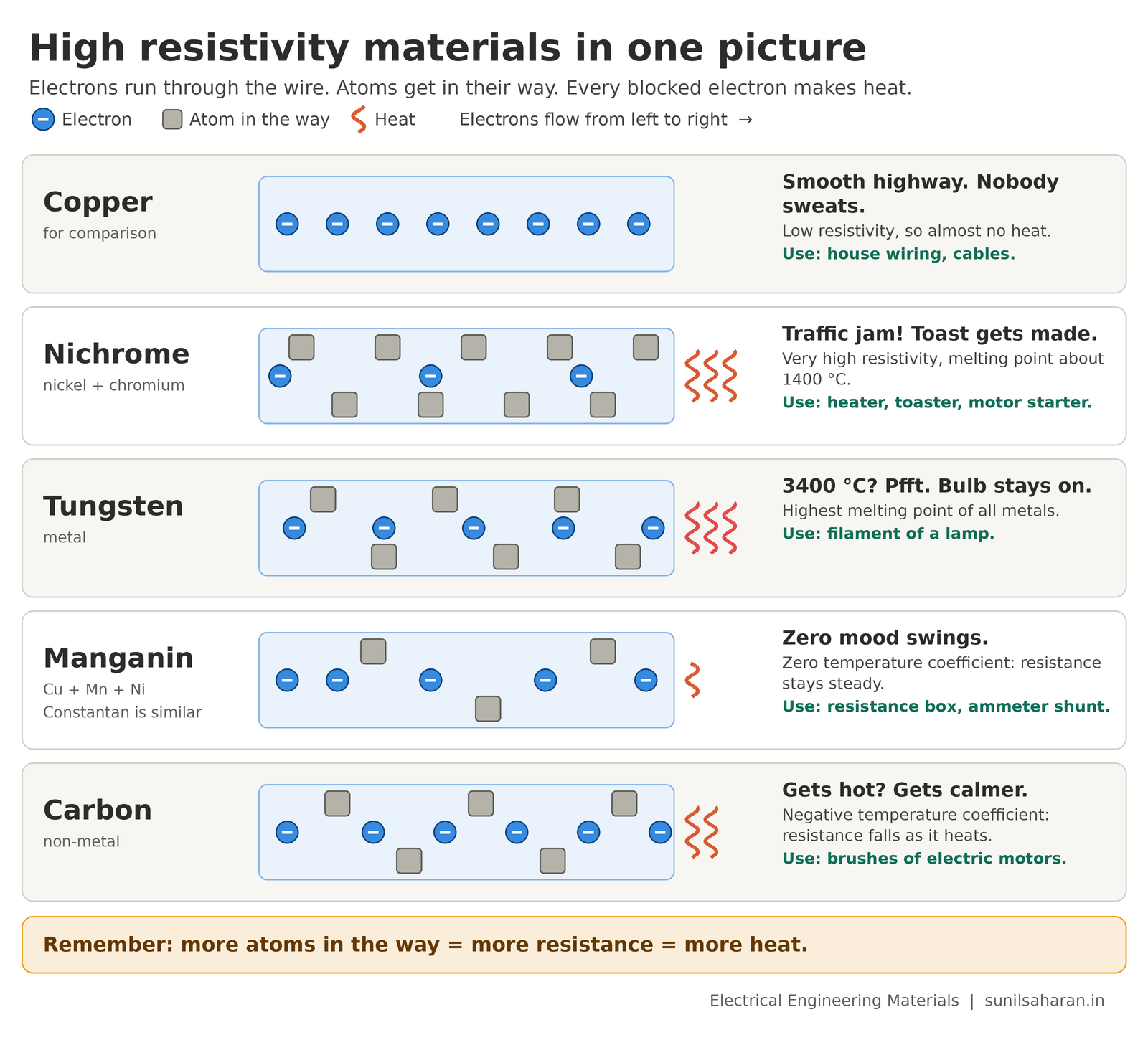
Everyday Examples to Remember
- The coil of a room heater and a toaster: nichrome.
- The filament of an old-type bulb: tungsten.
- The brushes in a mixer or drill motor: carbon.
- The resistance box in a physics laboratory: manganin or constantan.
MCQ and True/False Facts
- Manganin has zero temperature coefficient of resistance.
- Carbon has a negative temperature coefficient of resistance.
- Nichrome is used for winding the coils of DC motor starters.
- Brushes of a slip-ring induction motor are made of carbon.
- Tungsten has the highest melting point of all metals.
- Constantan is also called eureka.
Important Questions for Examinations
Short Answer Questions
- Write the properties and applications of constantan (eureka).
- State the important properties and applications of tungsten.
- Write the properties and applications of nichrome.
- Write the properties and applications of manganin.
- Write the properties and applications of carbon.
- Write the properties and one application each of platinum, mercury, lead, phosphor bronze and tin-lead alloy.
Long Answer Question
- Discuss high resistivity conducting materials with their properties and applications.
Quick Revision
- High resistivity materials produce heat or give a steady resistance.
- Constantan (copper + nickel) and manganin (copper + manganese + nickel): very low or zero temperature coefficient, so used in resistance boxes and instruments.
- Nichrome (nickel + chromium): heating elements and starter coils.
- Tungsten: highest melting point, used as lamp filament.
- Carbon: negative temperature coefficient, used for brushes.
- Platinum, mercury, lead, phosphor bronze and tin-lead alloy: special uses, see the table.
Related Topics to Study Next
Before this note: Low Resistivity Materials; Conducting Materials: Low and High Resistivity Materials. Next: Germanium and Silicon. Later: Soldering and Fuse (Unit V).
Conclusion
High resistivity materials are chosen for their special feature: nichrome for heat, tungsten for very high temperature, manganin and constantan for steady resistance, and carbon for brushes. Remember each material with its one key property and one key use, and you can answer both the short and the long question on this topic.
More notes in Electrical Engineering Materials
- Soft Magnetic Materials: Silicon Steel, C.R.G.O., Nickel-Iron, Mu Metal and Soft Ferrites
- Hysteresis Loss, Eddy Current Loss and Properties of Good Magnetic Materials
- Mica, Asbestos, Ceramics, Glass and Other Solid Insulating Materials
- Plastics as Insulating Materials: PVC, Bakelite, Epoxy Resin, Melamine, Teflon and Others
- Gaseous and Liquid Insulating Materials: Air, Nitrogen, SF6, Mineral Oil and Pyranol
- Insulating Materials: Properties and Classification
Comments (0)
Sign in or create an account to leave a comment.
No comments yet.