AC Drives: Phase Control, Variable Frequency and Constant V/f Control
Ch. Devi Lal Government Polytechnic, Nathusari Chopta › Diploma in Engineering (Polytechnic) › Electrical Engineering › Semester 5
AC Drives: Phase Control, Variable Frequency and Constant V/f Control
Most of the motors in industry are three-phase AC induction motors, because they are cheap, strong and need almost no maintenance. But an induction motor runs at an almost fixed speed. To control its speed, we must change the voltage or the frequency fed to it. A thyristor circuit that does this is called an AC drive.
In this note you will learn how the speed of an induction motor can be controlled, the advantages of an AC drive over a DC drive, and the three control methods of this syllabus: phase control, variable frequency control and constant V/f control. For inverters, see the Unit III note on inverters (see Related Topics).
1. AC Drive and Speed of an Induction Motor
Definition: An AC drive is an electric drive in which an AC motor (usually an induction motor) is controlled by a thyristor converter that changes the voltage and/or the frequency fed to the motor.
The speed of an induction motor is given by:
Ns = 120 f / P and N = Ns (1 − s)
where Ns is the synchronous speed in rpm, f is the supply frequency, P is the number of poles, s is the slip and N is the rotor speed (standard textbook relations). So the speed can be changed by changing the frequency, the number of poles, or the slip (which depends on the stator voltage and the rotor resistance).
| Method | What is changed | Remark |
|---|---|---|
| Stator voltage control (phase control) | Voltage, so the slip | Simple; small speed range; used for fans and pumps |
| Variable frequency control | Frequency f (and the voltage) | Wide, smooth speed range; the best method |
| Pole changing | Number of poles P | Gives only a few fixed speeds |
| Rotor resistance control | Slip (slip-ring motor only) | Wasteful |
2. Advantages of AC Drives over DC Drives
- An AC (squirrel cage) motor is cheaper and lighter than a DC motor of the same rating.
- It has no commutator and brushes, so the maintenance is very low and there is no sparking.
- It is rugged and can work in dirty, dusty and explosive places.
- It can be built for higher speeds and higher power ratings.
- It has a higher efficiency and a longer life.
| Point | AC drive | DC drive |
|---|---|---|
| Motor | AC (induction) motor | DC motor |
| Cost and size | Lower cost, smaller and lighter | Higher cost, larger |
| Maintenance | Very low (no commutator, no brushes) | High (brushes and commutator wear) |
| Working place | Dusty and explosive places also | Not suitable (sparking) |
| Speed and power limit | Higher | Lower (commutator limit) |
| Control circuit | More complex (voltage and frequency) | Simpler (only voltage) |
| Converter used | AC voltage controller, inverter, cyclo-converter | Controlled rectifier, chopper |
Exam tip: “What is an AC drive?” has been asked as a 1-mark question, “list four advantages of AC drive over DC drive” has been asked as a 4-mark question, and “differentiate between AC drives and DC drives” has also been asked as a 4-mark question.
3. Phase Control of an AC Drive (Stator Voltage Control)
Circuit: A pair of back-to-back SCRs (or a TRIAC) is connected in each line between the three-phase supply and the induction motor. This is an AC voltage controller (Fig. 1).
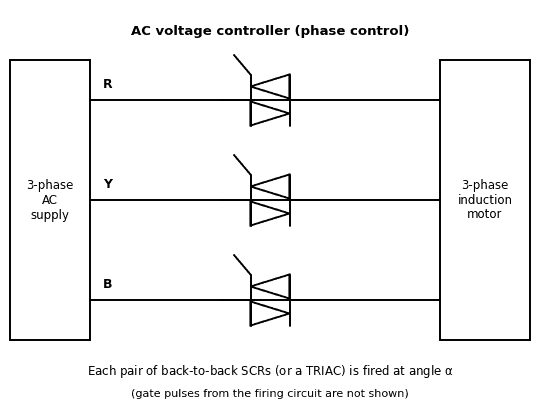 Fig. 1: AC voltage controller for an induction motor (circuit sketch)
Diagram in words: A three-phase supply (R, Y and B) is connected to a three-phase induction motor through three lines. In each line, a pair of back-to-back SCRs (drawn as one TRIAC symbol) is connected. The pairs are fired at the firing angle α by a firing circuit.
Working:
- The SCRs are fired at the firing angle α in each half cycle. Late firing cuts a part of the wave, so the RMS voltage fed to the motor is reduced.
- The torque of an induction motor is proportional to the square of the stator voltage (textbook statement). So, if the voltage is reduced, the torque falls.
- For a given load torque, the motor now has to run at a larger slip, so the speed falls.
- If α is decreased, the voltage and the speed increase.
Advantages: The circuit is simple and cheap. It also gives a soft start.
Limitations: The speed range is small. At a low speed, the slip is large, so the rotor losses are high and the efficiency is low. The wave contains harmonics.
Applications: Fans, blowers, pumps and small motors, where the load torque falls at low speed.
4. Variable Frequency AC Drive
Since Ns = 120 f / P, the speed of an induction motor is nearly proportional to the supply frequency. So, if a converter gives a variable frequency, the speed can be controlled over a wide range, smoothly and efficiently.
Block diagram (Fig. 2): AC supply → rectifier → DC link → inverter → induction motor, with a control circuit.
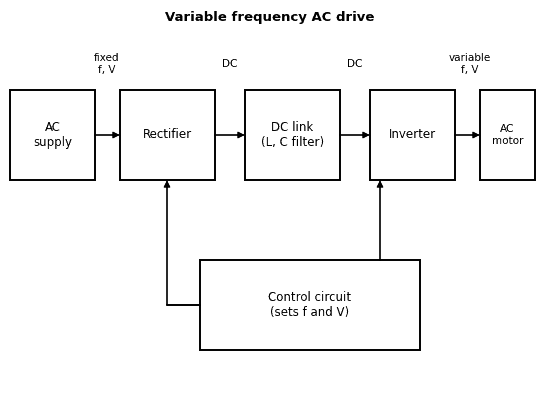 Fig. 2: Variable frequency AC drive (block diagram)
Diagram in words: Five boxes are joined in a row: AC supply (fixed frequency and voltage), rectifier, DC link with an L-C filter, inverter and AC motor (variable frequency and voltage). A control circuit below the row sends signals to the rectifier and to the inverter, and it sets the frequency and the voltage.
Working:
- The rectifier converts the fixed-frequency AC supply into DC. It may be a controlled rectifier (which can also vary the DC voltage) or a diode rectifier.
- The DC link has an inductor and a capacitor (L-C filter) that smooth the DC.
- The inverter converts the DC into AC of variable frequency and voltage (Unit III). In practice, a pulse width modulated (PWM) inverter is common.
- The control circuit sets the frequency according to the speed command, and changes the voltage along with the frequency so that the V/f ratio stays constant (Section 5).
- To increase the speed, the frequency is increased. To slow down, the frequency is lowered.
Advantages: Wide and smooth speed control, soft starting, high efficiency, and regenerative braking is possible if the converter can return power.
Applications: Pumps, fans, conveyors, machine tools, lifts and electric vehicles.
Exam tip: “What is the AC drive control? Explain variable frequency AC drives” has been asked as an 8-mark question.
5. Constant V/f Control
The flux of an induction motor is proportional to the ratio V / f (from the emf equation, E = 4.44 f Nph φ, which is a textbook relation). If the frequency is lowered and the voltage is kept the same, the flux increases and the motor core saturates. If the frequency is raised and the voltage is kept the same, the flux falls and the torque falls.
So, when the frequency is changed, the voltage is changed in the same ratio. This is constant V/f control (Fig. 3).
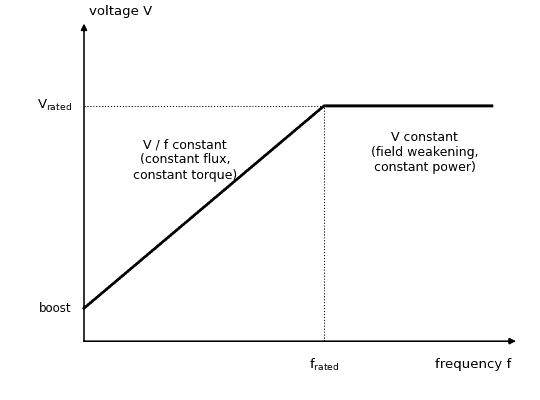 Fig. 3: Constant V/f control characteristic (sketch)
Diagram in words: The horizontal axis is the frequency and the vertical axis is the voltage. The line starts at a small voltage (the boost) at zero frequency and rises in a straight line to the rated voltage at the rated frequency. This part is the constant V/f region. After the rated frequency, the line is horizontal (voltage constant), which is the field weakening region.
- Below the rated (base) frequency: V / f is kept constant. The flux stays constant, and the motor can give its full (constant) torque.
- At very low frequency: The voltage drop in the stator resistance becomes large compared with the supply voltage, so a small extra voltage (boost) is given.
- Above the rated frequency: The voltage cannot be raised above its rated value, so V is kept constant and f is increased. V / f falls, the flux weakens (field weakening), and the motor works at constant power with a falling torque.
Everyday Examples to Remember
- A modern washing machine or air conditioner with an inverter: the speed of the motor is changed by changing the frequency.
- A water pump whose speed is lowered to save power when less water is needed.
- An electric train with AC induction motors, controlled by an inverter.
MCQ and True/False Facts
- An AC drive controls an AC motor with a thyristor converter.
- The synchronous speed is Ns = 120 f / P.
- An AC drive has less maintenance than a DC drive, because it has no commutator and brushes.
- In a variable frequency drive, the voltage is changed along with the frequency (constant V/f).
Important Questions for Examinations
Short Answer Questions
- What is an AC drive? State the advantages of an AC drive over a DC drive.
- Differentiate between AC drives and DC drives.
- Explain the phase control of an AC drive.
- Explain the working of a variable frequency AC drive with a block diagram.
- Explain constant V/f control of an AC drive.
Long Answer Questions
- What is the AC drive control? Explain variable frequency AC drives.
Quick Revision
- Ns = 120 f / P. Speed control by voltage (phase control) or by frequency (VFD).
- Phase control: back-to-back SCRs in each line; simple; small speed range; for fans and pumps.
- VFD: rectifier, DC link, inverter. Wide speed range, high efficiency.
- Constant V/f: constant flux and torque below the rated frequency; constant V above it (constant power).
- AC drive advantages: cheap, rugged, low maintenance, high speed and power.
Related Topics to Study Next
Electric Drives: Concept, Block Diagram and Advantages; DC Drives; Cyclo-Converter Controlled AC Drives and Electric Braking; Inverters (Unit III); Cyclo-Converters (Unit III).
Conclusion
An AC drive controls an induction motor by changing the voltage or the frequency. Phase control is simple but gives only a small speed range, while the variable frequency drive, with constant V/f control, gives a wide speed range with high efficiency, and it is the most common AC drive today.
More notes in Industrial Electronics & Control of Drives
- Cyclo-Converter Controlled AC Drives and Electric Braking
- DC Drives: Speed Control, Half-Wave, Full-Wave and Chopper Drives
- Electric Drives: Concept, Block Diagram and Advantages
- Thyristor (SCR) - Protection Methods and Technologies
- SCR : Construction, Working and V-I characterstics - Detailed
- Construction of SCR(Thyristor) | SCR Internal Arrangement
Comments (0)
Sign in or create an account to leave a comment.
No comments yet.