Electric Drives: Concept, Block Diagram and Advantages
Ch. Devi Lal Government Polytechnic, Nathusari Chopta › Diploma in Engineering (Polytechnic) › Electrical Engineering › Semester 5
Electric Drives: Concept, Block Diagram and Advantages
A lift, a ceiling fan, a lathe, a metro train and a washing machine all have one thing in common: a motor moves a load, and a control circuit decides how fast and how strongly the motor works. Such a system is called an electric drive. In this unit you will learn how thyristor circuits (SCRs, TRIACs, converters and inverters) are used to control electric drives.
In this note you will learn what an electric drive is, its parts and block diagram, its advantages, the types of drives, and the meaning of DC drive and AC drive. The converters used for control are in Unit II (controlled rectifiers) and Unit III (inverters, choppers, dual converters and cyclo-converters).
1. What Is an Electric Drive?
Definition: An electric drive is a system that controls the motion of a mechanical load (its speed, torque, direction, starting and stopping) by using an electric motor together with a power converter and a control unit.
Why thyristors are used: A thyristor converter can change the voltage, current or frequency fed to the motor smoothly and with very little power loss. This gives smooth, step-less control of the motor with high efficiency.
Exam tip: “What is an electric drive?” has been asked as a 1-mark question, and “concept of electric drive” has been asked as a short note.
2. Block Diagram of an Electric Drive
A complete drive has the following parts (Fig. 1).
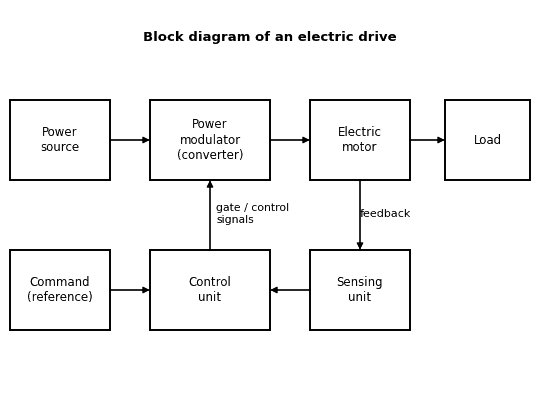 Fig. 1: Block diagram of an electric drive
Diagram in words: The top row has four boxes joined by arrows from left to right: power source, power modulator (converter), electric motor and load. The bottom row has the command (reference) box, the control unit and the sensing unit. An arrow goes from the command box to the control unit, and an arrow goes up from the control unit to the power modulator (gate or control signals). An arrow goes down from the motor to the sensing unit (feedback), and an arrow goes from the sensing unit to the control unit.
| Part | Function |
|---|---|
| Power source | Gives electrical energy to the drive: the AC mains or a DC supply (battery) |
| Power modulator (converter) | Controls the power that flows from the source to the motor. It can be a controlled rectifier, a chopper, an inverter, a cyclo-converter or an AC voltage controller. It also limits the starting current and selects motoring or braking. |
| Electric motor | Changes electrical energy into mechanical energy: a DC motor or an AC motor |
| Load | The machine to be driven: a fan, pump, lift, rolling mill and so on |
| Control unit | Compares the command with the feedback and gives gate pulses to the power modulator |
| Sensing unit | Measures the speed, current or torque and gives feedback to the control unit |
| Command (reference) | The desired value, for example, the set speed |
Working: The operator sets the command (for example, a speed). The control unit gives gate pulses to the power modulator, which feeds a suitable voltage (and frequency) to the motor. The motor drives the load. The sensing unit measures the actual speed and sends it back. The control unit corrects the gate pulses until the actual speed is equal to the set speed. This is a closed-loop drive.
Exam tip: “Draw and explain the block diagram of an electric drive” has been asked as a 4-mark question.
3. Advantages of Electric Drives
- Easy and smooth control of speed, torque, starting and stopping.
- Quick response; the drive can be started at once and needs no warming up.
- High efficiency, and no fumes or smoke, so the working place stays clean.
- Low noise and low maintenance cost.
- Available for a very wide range of power and speed (from a few watts to many megawatts).
- Remote control and automatic control are easy.
- Electric braking is possible, and in regenerative braking the energy is returned to the source.
Exam tip: “List four advantages of electric drive” has been asked as a 4-mark question.
4. Types of Electric Drives
(a) By the type of motor and supply:
- DC drive: A drive in which a DC motor is controlled by a variable DC voltage obtained from a thyristor converter (controlled rectifier or chopper). The speed is controlled by changing the voltage fed to the motor.
- AC drive: A drive in which an AC motor (usually an induction motor) is controlled by a thyristor converter that changes the voltage and the frequency fed to the motor (AC voltage controller, inverter or cyclo-converter).
(b) By the arrangement of motors and machines (textbook classification):
| Type | Meaning | Example |
|---|---|---|
| Individual drive | One motor drives one machine | A ceiling fan, a lathe with its own motor |
| Group drive | One motor drives several machines through a common shaft and belts | Old workshops with line shafts |
| Multi-motor drive | Different motors drive the different moving parts of one machine | A crane, a rolling mill, a paper machine |
Exam tip: “What do you mean by DC drive?” and “What is an AC drive?” have been asked as 1-mark questions.
Everyday Examples to Remember
- A ceiling fan with a regulator: the regulator is the power modulator, and the fan motor is the motor.
- A lift: the motor, the control unit that stops at the right floor, and the sensing unit that knows the position.
- An electric scooter: a battery (source), a controller (modulator), a motor and the wheel (load).
MCQ and True/False Facts
- An electric drive controls the motion of a load using an electric motor and a controller.
- The power modulator controls the power flowing from the source to the motor.
- The sensing unit gives feedback to the control unit.
- A DC drive uses a DC motor, and an AC drive uses an AC motor.
Important Questions for Examinations
Short Answer Questions
- What is an electric drive? Draw its block diagram and explain.
- List the advantages of electric drives.
- What do you mean by a DC drive and an AC drive?
- Explain the types of electric drives (individual, group and multi-motor drives).
Long Answer Questions
- Explain the concept of an electric drive with its block diagram, parts, advantages and types.
Quick Revision
- Electric drive = motor + power modulator (converter) + control unit + sensing unit, driving a load.
- Power modulator: controlled rectifier, chopper, inverter, cyclo-converter or AC voltage controller.
- Feedback from the sensing unit makes a closed-loop drive.
- Advantages: smooth control, quick response, efficiency, clean, low maintenance, easy automation, electric braking.
- DC drive: DC motor. AC drive: AC motor.
Related Topics to Study Next
DC Drives: Speed Control, Half-Wave, Full-Wave and Chopper Drives; AC Drives: Phase Control, Variable Frequency and Constant V/f Control; Cyclo-Converter Controlled AC Drives and Electric Braking; Controlled Rectifiers (Unit II); Choppers and Inverters (Unit III).
Conclusion
An electric drive is a motor with a power converter and a control unit that together control the speed and torque of a load. Thyristor converters make the control smooth, efficient and easy to automate. The next notes show how DC drives and AC drives are controlled.
More notes in Industrial Electronics & Control of Drives
- Cyclo-Converter Controlled AC Drives and Electric Braking
- AC Drives: Phase Control, Variable Frequency and Constant V/f Control
- DC Drives: Speed Control, Half-Wave, Full-Wave and Chopper Drives
- Thyristor (SCR) - Protection Methods and Technologies
- SCR : Construction, Working and V-I characterstics - Detailed
- Construction of SCR(Thyristor) | SCR Internal Arrangement
Comments (0)
Sign in or create an account to leave a comment.
No comments yet.