Construction of SCR(Thyristor) | SCR Internal Arrangement
By Sunil Saharan · 12 Aug 2012 · updated 12 Mar 2018 · 4,638 views
This article describes basics of SCR, construction of thyristor and its working
SCR is one of the most important member of semiconductor family, quickly replacing other Power Electronics devices. The construction of SCR is very simple.
The first SCR was developed in Bell Laboratories by General Electrical Company of USA in 1956. Silicon is the main material used for the construction of SCR.
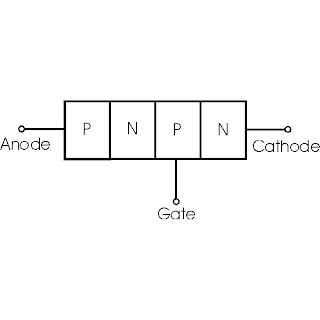 SCR construction shown above clearly indicates all the four layers of the SCR. The Terminal connection taken from outer most P-layer is named as Anode/A (Positive Terminal), Terminal taken from outermost N-layer is named as Cathode/K (Negative Terminal) and terminal taken from inner P-layer is named as Gate terminal of SCR.
Below is the symbol of SCR
SCR construction shown above clearly indicates all the four layers of the SCR. The Terminal connection taken from outer most P-layer is named as Anode/A (Positive Terminal), Terminal taken from outermost N-layer is named as Cathode/K (Negative Terminal) and terminal taken from inner P-layer is named as Gate terminal of SCR.
Below is the symbol of SCR

It is very similar to diode except the gate terminal as shown.
What is SCR
SCR is a four layer semiconductor device which is unidirectional in nature. Unidirectional refer to its property to conduct in one direction only. It means an SCR will allow current to flow when it is forward biased and no current will flow through it when SCR is reverse biased. An SCR has three terminals viz. Anode(denoted by A), Cathode (denoted by K) and Gate (denoted by G).Construction of SCR
As I told SCR consists of silicon junctions and there are total four layers and three junctions in an SCR.For convenience these junctions may be named as J1, J2 and J3 as shown in SCR construction below.
SCR construction shown above clearly indicates all the four layers of the SCR. The Terminal connection taken from outer most P-layer is named as Anode/A (Positive Terminal), Terminal taken from outermost N-layer is named as Cathode/K (Negative Terminal) and terminal taken from inner P-layer is named as Gate terminal of SCR.
Below is the symbol of SCRIt is very similar to diode except the gate terminal as shown.